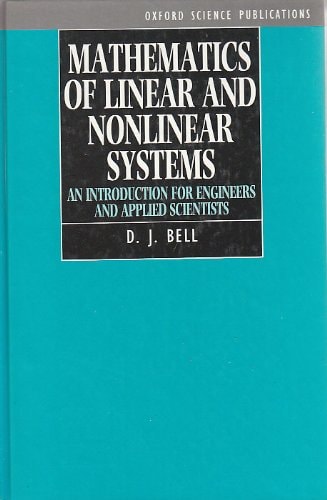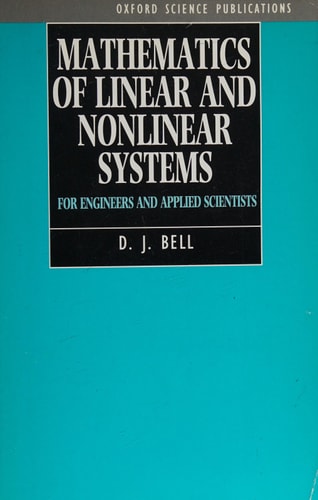
Mathematics of Linear and Nonlinear Systems: For Engineers and Applied Scientists
0
0
As an Amazon Associate and affiliate partner, Menrva Books earns from qualifying purchases. Learn more
Author Description
Dynamical systems are evident in many aspects of daily life and occur either as controlled systems like a piloted aircraft or uncontrolled systems such as the solar system). Many dynamical systems can be described mathematically and the resulting mathematical models are usually nonlinear. These models can often be linearized and yet still reflect the essential features of the real systems. During the last 30 years, the mathematical theory for linear and nonlinear, controlled and uncontrolled, and continuous and discrete mathematical models has been formulated using highly sophisticated mathematics. The background mathematical knowledge required to understand this modern formulation is not normally acquired by graduates in subjects other than mathematics. Nearly all the relevant books have been written by mathematicians, for mathematicians, and nonmathematicians often have considerable difficulty in approaching the subject. This book presents, in a convenient single volume ideal for nonmathematicians, much of the mathematical background necessary for the study of modern developments in linear and nonlinear system theory. Six chapters cover algebraic topics that have been instrumental in the establishment of linear system theory, including groups, rings, modules, and vector spaces. The last five chapters deal with those parts of analysis which lead to a geometric approach to nonlinear system theory that has been particularly successful in yielding important results since about 1970. With many examples, notes and exercises with solutions, this work can be used as either a textbook or reference.
Menrva's Summary
THE THESIS
This book investigates the mathematical foundations required for engineers and applied scientists to understand modern linear and nonlinear system theory. D. J. Bell, drawing on his expertise in control theory and applied mathematics, addresses the gap between abstract mathematical literature and the practical needs of non-mathematicians. The text provides a bridge by synthesizing algebraic and analytical concepts into a single volume, specifically tailored for those working with controlled and uncontrolled dynamical systems.
THE SCOPE MAP
What You Will Find
- Algebraic foundations including groups, rings, modules, and vector spaces.
- Analytical methods supporting a geometric approach to nonlinear system theory.
- Practical examples and exercises with provided solutions for self-study.
- A structured framework for transitioning from linearized models to complex nonlinear dynamics.
THE AUTHORITY PERSPECTIVE
Experts recognize this work as a valuable resource for bridging the gap between pure mathematics and engineering applications. Readers frequently note that the text provides a necessary, accessible entry point for students and professionals who lack a formal background in advanced mathematical theory.
Page Count:
320
Publication Date:
1991-11-07
Publisher:
Oxford University Press
ISBN-10:
0198563639
ISBN-13:
9780198563631
Engineering
textbook
Science - Mathematics
Mathematics
Linear Systems
Applied Science