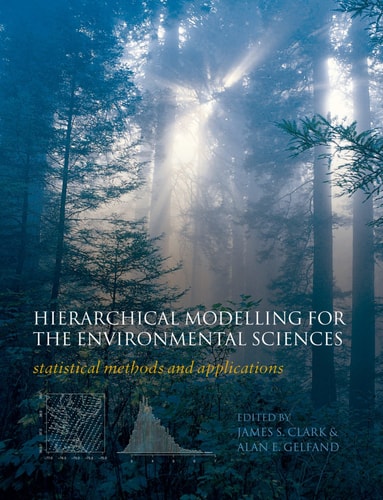
Hierarchical Modelling for the Environmental Sciences: Statistical Methods and Applications
0
0
As an Amazon Associate and affiliate partner, Menrva Books earns from qualifying purchases. Learn more
Author Description
New statistical tools are changing the ways in which scientists analyze and interpret data and models. Many of these are emerging as a result of the wide availability of inexpensive, high speed computational power. In particular, hierarchical Bayes and Markov Chain Monte Carlo methods for anyalsis provide consistent framework for inference and prediction where information is heterogeneous and uncertain, processes are complex, and responses depend on scale. Nowhere are these methods more promising than in the environmental sciences. Models have developed rapidly, and there is now a requirement for a clear exposition of the methodology through to application for a range of environmental challenges.
Menrva's Summary
THE THESIS
How can hierarchical Bayesian modeling and Markov Chain Monte Carlo methods be effectively applied to address the complex, uncertain, and multi-scale data challenges inherent in environmental science? Authors Alan E. Gelfand and James S. Clark provide a rigorous examination of modern statistical tools that leverage high-speed computational power to interpret environmental data. The text establishes a consistent framework for inference and prediction, specifically designed for scenarios where information is heterogeneous and processes are non-linear. By bridging the gap between theoretical methodology and practical application, the authors offer a structured approach to modeling environmental phenomena.
THE SCOPE MAP
What You Will Find
- Hierarchical Bayesian modeling frameworks for complex environmental systems
- Markov Chain Monte Carlo (MCMC) computational methodologies
- Statistical techniques for handling heterogeneous and uncertain data sets
- Applications of multi-scale modeling in ecological and environmental research
THE AUTHORITY PERSPECTIVE
Experts recognize this text as a foundational resource for researchers and graduate students seeking to integrate advanced statistical inference into environmental studies. Readers frequently note the technical density of the prose, which requires a solid background in statistics to fully utilize the provided methodologies.
Page Count:
216
Publication Date:
2006-06-29
Publisher:
Oxford University Press
ISBN-10:
019856967X
ISBN-13:
9780198569671
Science
Statistics
Mathematics
Data Analysis
Decision Theory
Community Tags
Similar Books