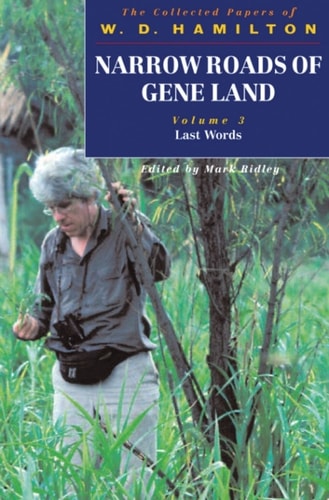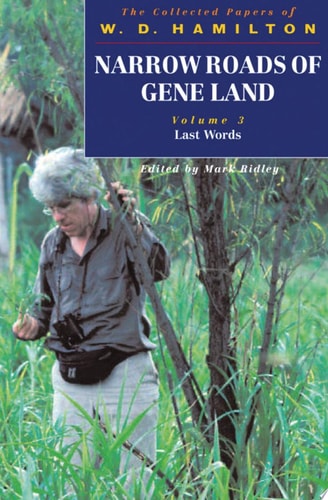
Narrow Roads of Gene Land: The Collected Papers of W. D. Hamilton, Volume 3 - Last Words
0
0
As an Amazon Associate and affiliate partner, Menrva Books earns from qualifying purchases. Learn more
Author Description
W. D. Hamilton (1936-2000) has been described by Richard Dawkins as 'a good candidate for the title of most distinguished Darwinian since Darwin'. His work on evolutionary biology continues to influence scientists working across a wide variety of disciplines, including evolution, population genetics, animal behaviour, genetics, anthropology, and ecology. This third and final volume of Narrow Roads of Gene Land contains Hamilton's key papers published between 1990 and 2000, a period in which he covered a great diversity of topics, often in collaboration with other scientists. Many of the papers in this volume continue his work on sex, and particularly its relation to parasitic disease, but other topics covered include the Gaia theory, the colours of autumn leaves, and the still-controversial hypothesis that the AIDS pandemic accidentally originated in a polio vaccination campaign in Africa.Each of the co-authored papers in this volume is preceded by an introduction written by one of Hamilton's co-authors, following the model of the previous two volumes in this series, which brings the reader closer to Hamilton's extraordinary personality and intellect, providing the intellectual and physical contexts within which each piece of research was developed. Also included are a chapter by Jeremy Leighton John on the Hamilton archive - 'Bill's last great work' - complete with irresistible pictures, and Alan Grafen's biographical memoir, which presents an overview of Bill's life and work. Together, this unique collection of papers with their biographical introductions provides a profound portrait of one of the twentieth century's most innovative scientists.
Menrva's Summary
THE THESIS
This volume investigates the final decade of W. D. Hamilton's scientific contributions, examining how his theories on evolutionary biology, sex, and disease continued to shape modern biological discourse. The author, a preeminent Darwinian theorist, presents a collection of papers that bridge the gap between theoretical population genetics and practical applications in ecology and anthropology. By contextualizing these works through co-author introductions and biographical memoirs, the text provides a comprehensive overview of Hamilton's intellectual development and his influence on the scientific community during the late twentieth century.
THE SCOPE MAP
What You Will Find
- A curated collection of key research papers published by W. D. Hamilton between 1990 and 2000.
- Detailed explorations of the relationship between sexual reproduction and parasitic disease.
- Scientific inquiries into diverse topics including the Gaia theory, the evolution of autumn leaf coloration, and the origins of the AIDS pandemic.
- Biographical memoirs and archival documentation providing insight into Hamilton's personal and professional life.
THE AUTHORITY PERSPECTIVE
Experts and peers recognize this volume as a critical archival resource for understanding the evolution of modern biological thought. Readers frequently note the academic density of the prose, which serves as a foundational reference for those studying the history of evolutionary biology.
Page Count:
496
Publication Date:
2006-01-12
Publisher:
Oxford University Press
ISBN-10:
0198566905
ISBN-13:
9780198566908
Science
Biography
Genetics
Social Behavior
Anthropology
Ecology
Behavior evolution
Evolutionary Biology
Community Tags
Similar Books