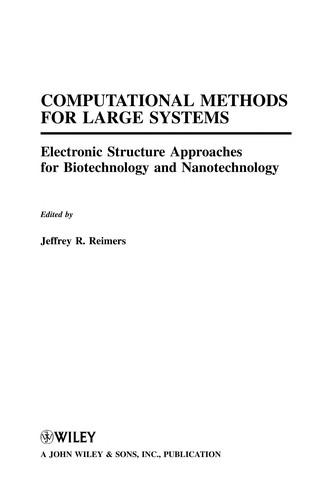
Computational Methods for Large Systems
0
0
As an Amazon Associate and affiliate partner, Menrva Books earns from qualifying purchases. Learn more
Author Description
While its results normally complement the information obtained by chemical experiments, computer computations can in some cases predict unobserved chemical phenomena Electronic-Structure Computational Methods for Large Systems gives readers a simple description of modern electronic-structure techniques. It shows what techniques are pertinent for particular problems in biotechnology and nanotechnology and provides a balanced treatment of topics that teach strengths and weaknesses, appropriate and inappropriate methods. It's a book that will enhance the your calculating confidence and improve your ability to predict new effects and solve new problems. Provides a simple description of modern electronic-structure techniques. Shows what techniques are pertinent for particular problems in biotechnology and nanotechnology. Provides a balanced treatment of the topics that teaches strengths and weaknesses, appropriate and inappropriate methods. Provides confidence to calculators that their results are useful for predicting new effects and for interpreting newly presented problem scenarios - reference tool for industrial scientists who develop applications as well as a teaching aid for new graduate students in computational chemistry, physics, biochemistry, biotechnology, materials science and nanoscience
Menrva's Summary
THE THESIS
This book explores modern electronic-structure computational techniques and their application to complex systems. It aims to provide readers with a clear understanding of these methods, highlighting their relevance to problems in biotechnology and nanotechnology. The text offers a balanced perspective on the strengths and weaknesses of various techniques, guiding users on appropriate and inappropriate applications. Ultimately, it seeks to enhance computational confidence and improve the ability to predict new chemical phenomena and solve novel problems.
THE SCOPE MAP
- Introduction to modern electronic-structure computational techniques.
- Pertinent techniques for biotechnology applications.
- Pertinent techniques for nanotechnology applications.
- Balanced treatment of strengths and weaknesses of computational methods.
- Guidance on appropriate and inappropriate method selection.
- Enhancing calculating confidence for predicting new effects.
- Reference tool for industrial scientists.
- Teaching aid for graduate students in computational chemistry, physics, biochemistry, materials science, and nanoscience.
THE AUTHORITY PERSPECTIVE
The book is presented as a valuable resource for both industrial scientists and graduate students. Its focus on providing a simple description of complex techniques and a balanced treatment of their pros and cons suggests it aims to be a practical and confidence-building tool. The emphasis on applications in biotechnology and nanotechnology indicates a contemporary and relevant scope for its intended audience.
Page Count:
0
Publication Date:
2011-01-01
ISBN-10:
0470487887
ISBN-13:
9780470487884
Non-Fiction
Science
Biotechnology
Nanotechnology
Computational Chemistry
Nanoscience
Community Tags
Similar Books