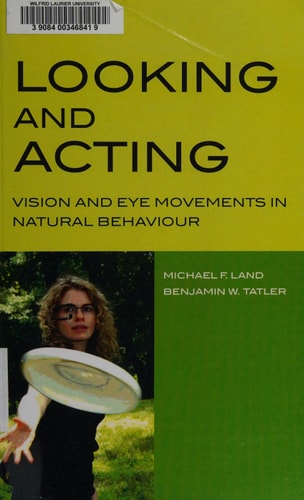
Looking and Acting: Vision and Eye Movements in Natural Behaviour
0
0
As an Amazon Associate and affiliate partner, Menrva Books earns from qualifying purchases. Learn more
Author Description
The cooperative action of different regions of our brains gives us an amazing capacity to perform activities as diverse as playing the piano and hitting a tennis ball. Somehow, without conscious effort, our eyes find the information we need to operate successfully in the world around us. The development of head-mounted eye trackers over recent years has made it possible to record where we look during different active tasks, and so work out what information our eyes supply to the brain systems that control our limbs. We are now in a position to explore the strategies that the eye movement system uses in the initiation and guidance of action.Looking and Acting examines a wide range of visually guided behaviour, from sedentary tasks like reading and drawing, to dynamic activities such as driving and playing cricket. A central theme is that the eye movement system has its own knowledge about where to find the most appropriate information for guiding action - information not usually available to conscious scrutiny. Thus each type of action has its own specific repertoire of linked eye movements, acquired in parallel with the motor skills themselves. Starting with a brief background to eye movement studies, the book then reviews a range of observations and analyses of different activities. It ends with discussions of the nature of visual representation, the neurophysiology of the systems involved, and the roles of attention and learning.Opening a field in eye movement research, this fascinating book will be of great interest to all vision scientists (psychologists, physiologists, ophthalmologists) whether at professional, graduate, or advanced undergraduate levels. It will also be of value to musicians, artists, sports scientists, and transport engineers, and indeed anyone intrigued by the way we sample the visual world.
Menrva's Summary
THE THESIS
How does the human eye movement system autonomously identify and acquire the specific visual information required to guide complex physical actions? The authors, Benjamin W. Tatler and Michael Land, utilize data derived from head-mounted eye-tracking technology to investigate the intersection of visual perception and motor control. They argue that the brain maintains specialized, non-conscious strategies for sampling the environment, which are developed in tandem with the acquisition of motor skills.
THE SCOPE MAP
What You Will Find
- Analysis of eye movement patterns across diverse activities including reading, drawing, driving, and sports.
- Examination of the neurophysiological systems that link visual input to limb control.
- Discussion of the role of attention and learning in shaping visual sampling strategies.
- Review of the nature of visual representation and its influence on task execution.
THE AUTHORITY PERSPECTIVE
Experts identify this text as a foundational resource for vision scientists, psychologists, and engineers interested in the mechanics of human behavior. Readers frequently note the technical clarity of the research, which bridges the gap between theoretical neuroscience and practical application in fields like sports science and transport engineering.
Page Count:
282
Publication Date:
2009-10-04
Publisher:
Oxford University Press
ISBN-10:
0198570945
ISBN-13:
9780198570943
Science
Psychology
Neuroscience
Eye Movements
Ophthalmology
Community Tags
Similar Books