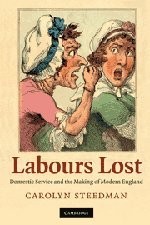
Labours Lost
0
0
As an Amazon Associate and affiliate partner, Menrva Books earns from qualifying purchases. Learn more
Author Description
This is a unique account of the hidden history of servants and their employers in late eighteenth-century England and of how servants thought about and articulated their resentments. It is a book which encompasses state formation and the maidservant pounding away at dirty nappies in the back kitchen; taxes on the servant's labour and the knives he cleaned, the water he fetched, and the privy he shovelled out. Carolyn Steedman shows how deeply entwined all of these entities, objects and people were in the imagination of those doing the shovelling and pounding and in the political philosophies that attempted to make sense of it all. Rather than fitting domestic service into conventional narratives of industrial revolution' or the making of the English working class' she offers instead a profound re-reading of this formative period in English social history which restores the servants' lost labours to their rightful place
Menrva's Summary
THE THESIS
This book uncovers the hidden history of servants and their employers in late eighteenth-century England, focusing on how servants perceived and expressed their grievances. Carolyn Steedman examines the intricate connections between state formation, taxation on domestic labor, and the daily tasks of servants, such as cleaning and waste disposal. The work challenges conventional narratives of the industrial revolution and the formation of the English working class by offering a re-reading that centers the often-overlooked contributions of domestic servants. It restores the significance of their 'lost labours' to their rightful place in understanding this formative period of English social history.
THE SCOPE MAP
- Exploration of the hidden history of servants and employers in late eighteenth-century England.
- Analysis of how servants articulated their resentments and grievances.
- Examination of the entanglement of state formation, taxation, and domestic service.
- Focus on specific tasks like pounding nappies, cleaning knives, and shoveling privies.
- Re-reading of the period, moving beyond industrial revolution and working-class narratives.
- Restoration of the significance of servants' 'lost labours' to social history.
- Inclusion of political philosophies that attempted to make sense of the era's social structures.
THE AUTHORITY PERSPECTIVE
This book is recognized for its profound re-reading of late eighteenth-century English social history, particularly by restoring the overlooked contributions of domestic servants. It is noted for its ability to connect grand narratives of state formation and political philosophy with the granular realities of servants' daily lives and resentments. The work is praised for challenging conventional historical interpretations, offering a more nuanced understanding of the period by centering the experiences of those performing essential but often unacknowledged labor. Its approach is seen as vital for a comprehensive grasp of English social history.
Page Count:
410
Publication Date:
2009-01-01
ISBN-10:
0521516374
ISBN-13:
9780521516372
History
Non-Fiction
Eighteenth Century
British History
Social History
Community Tags
Similar Books