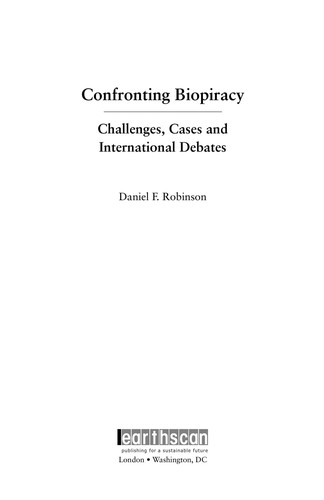
Confronting Biopiracy
0
0
As an Amazon Associate and affiliate partner, Menrva Books earns from qualifying purchases. Learn more
Author Description
'Biopiracy' refers either to the unauthorized extraction of biological resources, such as plants with medicinal properties, and associated traditional knowledge from indigenous peoples and local communities, or to the patenting of spurious 'inventions' based on such knowledge or resources without compensation. Biopiracy cases continue to emerge in the media and public eye, yet they remain the source of considerable disagreement, confusion, controversy and grief. The aim of this book is to provide the most detailed, coherent analysis of the issue of biopiracy to date. The book synthesizes the rise of the issue and increasing use of the term by activists and negotiators in the World Trade Organization (WTO) and the Convention on Biological Diversity (CBD), to form a critical understanding of the themes, implications and politics of biopiracy. Taking a case study-based approach, derived from interviews and fieldwork with researchers, government, industry, local farmers, healers and indigenous people, the author sequentially documents events that have occurred in biopiracy and bioprospecting controversies. Implications and ethical dilemmas are explored, particularly relating to work with local communities, and the power relations entailed. Detailing international debates from the WTO, CBD and other fora in an accessible manner, the book provides a unique overview of current institutional limitations and suggests ways forward. Options and solutions are suggested which are relevant for local communities, national governments, international negotiators, NGO and interest groups, researchers and industry.--Jacket.
Menrva's Summary
THE THESIS
This book critically analyzes the complex issue of biopiracy, defined as the unauthorized extraction of biological resources and traditional knowledge, or the patenting of spurious inventions based on them without compensation. The author, Daniel F. Robinson, synthesizes the rise of this term and its use in international forums like the WTO and CBD to foster a critical understanding of biopiracy's themes, implications, and politics. Through case studies derived from interviews and fieldwork with diverse stakeholders, the book sequentially documents biopiracy and bioprospecting controversies, exploring ethical dilemmas and power relations, particularly concerning local communities.
THE SCOPE MAP
- Detailed analysis of the definition and scope of biopiracy.
- Synthesis of the term's rise and use in international negotiations (WTO, CBD).
- Case studies based on interviews and fieldwork with researchers, industry, local farmers, healers, and indigenous people.
- Exploration of implications and ethical dilemmas, especially concerning local communities and power dynamics.
- Accessible detailing of international debates from various fora.
- Overview of current institutional limitations.
- Suggestions for ways forward, including options and solutions for various stakeholders.
THE AUTHORITY PERSPECTIVE
The book offers a detailed and coherent analysis of biopiracy, synthesizing its rise and political implications through a case study approach. It aims to provide a critical understanding for a diverse audience, including local communities, governments, negotiators, NGOs, researchers, and industry. The work is noted for its accessible detailing of international debates and its exploration of ethical dilemmas and power relations inherent in bioprospecting controversies. It concludes by suggesting potential solutions and ways forward within existing institutional limitations.
Page Count:
190
Publication Date:
2010-01-01
ISBN-10:
1844077225
ISBN-13:
9781844077229
Politics
Economics
Non-Fiction
Ethics
International Law
Intellectual Property
Biopiracy
Biodiversity
Traditional Knowledge
Community Tags
Similar Books