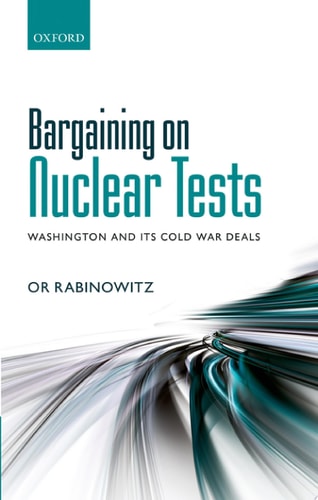
Bargaining on Nuclear Tests: Washington and its Cold War Deals
0
0
As an Amazon Associate and affiliate partner, Menrva Books earns from qualifying purchases. Learn more
Author Description
Most observers who follow nuclear history agree on one major aspect regarding Israel's famous policy of nuclear ambiguity; mainly that it is an exception. More specifically, it is largely accepted that the 1969 Nixon-Meir understanding, which formally established Israel's policy of nuclear ambiguity and transformed it from an undeclared Israeli strategy into a long-lasting undisclosed bilateral agreement, was in fact a singularity, aimed at allowing Washington to turn a blind eye to the existence of an Israeli arsenal. According to conventional wisdom, this nuclear bargain was a foreign policy exception on behalf of Washington, an exception which reflected a relationship growing closer and warmer between the superpower leading the free world and its small Cold War associate. Contrary to the orthodox narrative, this research demonstrates that this was not the case. The 1969 bargain was not, in fact, an exception, but rather the first of three Cold War era deals on nuclear tests brokered by Washington with its Cold War associates, the other two being Pakistan and South Africa. These two deals are not well known and until now were discussed and explored in the literature in a very limited fashion. Bargaining on Nuclear Tests places the role of nuclear tests by American associates, as well as Washington's attempts to prevent and delay them, at the heart of a new nuclear history narrative.
Menrva's Summary
THE THESIS
Does the 1969 Nixon-Meir nuclear ambiguity agreement represent a unique diplomatic anomaly, or is it part of a broader, recurring pattern of Cold War nuclear bargaining? Or Rabinowitz, a scholar specializing in nuclear proliferation and international security, challenges the conventional narrative that Israel's nuclear status was a singular exception in American foreign policy. By analyzing declassified documents and diplomatic records, the author argues that Washington engaged in similar clandestine bargaining with Pakistan and South Africa to manage the nuclear ambitions of its Cold War associates.
THE SCOPE MAP
What You Will Find
- Comparative analysis of nuclear non-proliferation strategies involving Israel, Pakistan, and South Africa.
- Examination of the 1969 Nixon-Meir understanding as a template for subsequent bilateral nuclear deals.
- Utilization of archival research and declassified diplomatic correspondence to reconstruct Cold War decision-making.
- A framework for understanding how the United States balanced global non-proliferation goals with specific regional security partnerships.
THE AUTHORITY PERSPECTIVE
Experts in nuclear history and international relations identify this work as a significant revisionist contribution to the study of Cold War diplomacy. Readers frequently note the academic rigor and the depth of archival evidence provided to support the author's claims regarding American nuclear policy.
Page Count:
256
Publication Date:
2014-06-24
Publisher:
Oxford University Press
ISBN-10:
0198702930
ISBN-13:
9780198702931
History
Israel
Nuclear weapons
International relations
Military History
Cold War
United States
Community Tags
Similar Books