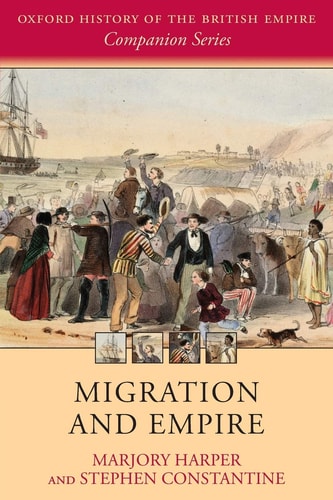
Migration and Empire
0
0
As an Amazon Associate and affiliate partner, Menrva Books earns from qualifying purchases. Learn more
Author Description
Migration and Empire provides a unique comparison of the motives, means, and experiences of three main flows of empire migrants. During the nineteenth century, the proportion of UK migrants heading to empire destinations, especially to Canada, Australia, and New Zealand, increased substantially and remained high. These migrants included so-called 'surplus women' and 'children in need', shipped overseas to ease perceived social problems at home. Empire migrants also included entrepreneurs and indentured labourers from south Asia, Africa, and the Pacific (together with others from the Far East, outside the empire), who relocated in huge numbers with equally transformative effects in, for example, central and southern Africa, the Caribbean, Ceylon, Mauritius, and Fiji. The UK at the core of empire was also the recipient of empire migrants, especially from the 'New Commonwealth' after 1945.These several migration flows are analysed with a strong appreciation of the commonality and the complex variety of migrant histories. The volume includes discussion of the work of philanthropists (especially with respect to single women and 'children in care') as well as governments and entrepreneurs in organising much empire migration, and the business of recruiting, assisting, and transporting selected empire migrants. Attention is given to immigration controls that restricted the settlement of some non-white migrants, and to the mixture of motives explaining return-migration. The study concludes by indicating why the special relationship between empire and migration came to an end. Legacies remain, but by the 1970s political change and shifts in the global labour market had eroded the earlier patterns.
Menrva's Summary
THE THESIS
This volume investigates the complex interplay between imperial expansion and human migration, questioning how the movement of people shaped the British Empire and its subsequent decline. Authors Marjory Harper and Stephen Constantine utilize extensive historical records to examine the diverse motivations and experiences of migrants across the nineteenth and twentieth centuries. By analyzing the structural forces of government policy, philanthropy, and labor markets, the authors provide a comprehensive framework for understanding the demographic shifts that defined the imperial era.
THE SCOPE MAP
What You Will Find
- Comparative analysis of migration flows from the UK to settler colonies like Canada, Australia, and New Zealand.
- Examination of labor migration from South Asia, Africa, and the Pacific, including indentured labor systems.
- Discussion of post-1945 migration patterns from the New Commonwealth to the UK.
- Evaluation of the role of philanthropic organizations and government recruitment in facilitating migration.
THE AUTHORITY PERSPECTIVE
Scholars and historians frequently cite this work as a definitive resource for understanding the demographic mechanics of the British Empire. The text is noted for its rigorous academic approach and its ability to synthesize disparate migration histories into a coherent narrative of imperial change.
Page Count:
400
Publication Date:
2014-06-17
Publisher:
Oxford University Press
ISBN-10:
0198703368
ISBN-13:
9780198703365
History
Migration Studies
Sociology
British Empire
Great Britain
Colonialism
Social History