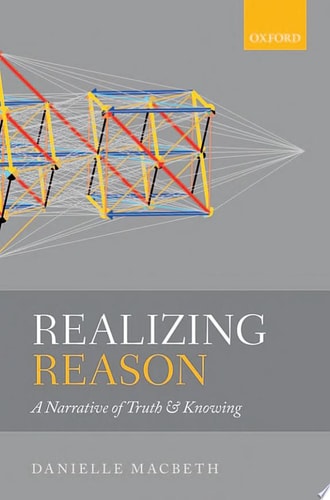
Realizing Reason: A Narrative of Truth and Knowing
0
0
As an Amazon Associate and affiliate partner, Menrva Books earns from qualifying purchases. Learn more
Author Description
Realizing Reason pursues three interrelated themes. First, it traces the essential moments in the historical unfolding--from the ancient Greeks, through Descartes, Kant, and developments in the nineteenth century, to the present--that culminates in the realization of pure reason as a power of knowing. Second, it provides a cogent account of mathematical practice as a mode of inquiry into objective truth. And finally, it develops and defends a new conception of our being in the world, one that builds on and transforms the now standard conception according to which our experience of reality arises out of brain activity due, in part, to merely causal impacts on our sense organs. Danielle Macbeth shows that to achieve an adequate understanding of the striving for truth in the exact sciences we must overcome this standard conception and that the way to do that is through a more adequate understanding of the nature of mathematical practice and the profound transformations it has undergone over the course of its history, the history through which reason is first realized as a power of knowing. Because we can understand mathematical practice only if we attend to the systems of written signs within which to do mathematics, Macbeth provides an account of the nature and role of written notations, specifically, of the principal systems that have been developed within which to reason in mathematics: Euclidean diagrams, the symbolic language of arithmetic and algebra, and Frege's concept-script, Begriffsschrift.
Menrva's Summary
THE THESIS
How does the historical development of mathematical practice reveal the nature of pure reason as a power of knowing? Danielle Macbeth, a scholar of philosophy, synthesizes historical inquiry with contemporary analysis to challenge the prevailing neurobiological reductionism regarding human experience. She argues that by examining the evolution of mathematical notation—from Euclidean diagrams to Frege’s concept-script—we can move beyond the standard causal model of perception to a more robust understanding of objective truth and rational inquiry.
THE SCOPE MAP
What You Will Find
- A historical survey of rationalist thought from the ancient Greeks through Descartes and Kant to modern developments.
- An analysis of mathematical practice as a distinct, objective mode of inquiry.
- A critique of the standard conception that equates human experience solely with brain activity and sensory input.
- A detailed examination of the role of written notation systems, including Euclidean diagrams and Frege’s Begriffsschrift, in the realization of reason.
THE AUTHORITY PERSPECTIVE
Experts recognize this work as a rigorous contribution to the philosophy of mathematics and the history of logic. Readers frequently note the academic density of the prose, which requires a strong background in philosophical terminology to fully grasp the author's arguments.
Page Count:
494
Publication Date:
2014-05-27
Publisher:
Oxford University Press
ISBN-10:
0198704755
ISBN-13:
9780198704751
Philosophy
Reason
Epistemology
Reasoning
Logic & Critical Reasoning
Logic
Comprehension
Truth
Mathematics
Community Tags
Similar Books