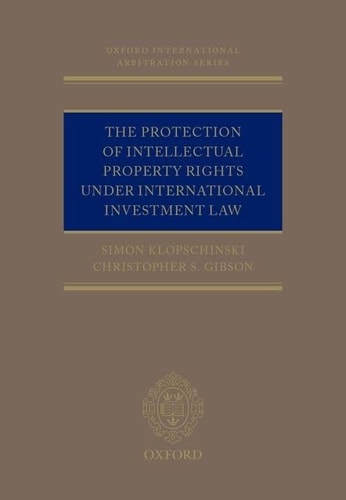
The Protection of Intellectual Property Rights Under International Investment Law
0
0
As an Amazon Associate and affiliate partner, Menrva Books earns from qualifying purchases. Learn more
Author Description
In recent decades, foreign direct investment (FDI) has played an increasingly significant role in world economic activity and development. In economic terms, the accumulated stock of FDI and its generation of commercial activity by foreign affiliates have made FDI comparatively more important than international trade in goods and services. While FDI has experienced long-term steady growth until the recent financial crisis, another powerful trend has been transforming an important part of modern economies: these economies are becoming predominantly 'conceptual', reflecting the vital role of ideas in common and highly valued products and services, and shifting the emphasis in asset valuation from physical to intellectual property (IP). As this trend continues, a similar change can be observed in FDI: foreign investments are reflecting an increasing concentration of intellectual capital invested in knowledge goods protected by intellectual property rights. Thus, IP rights have never been more economically and politically important or controversial than they are today.There have long been international treaties that protect IP, but in recent years other international treaties have come into being that protect IP rights along with other property rights. These treaties include various international investment agreements (IIAs), which regard IP rights as a protected investment.This book will analyse the standards of treatment and protection enshrined in IIAs for IP rights, with reference to topics such as the fragmentation of international law; investor-host-state dispute resolution; investors and investments; relative standards of treatment (such as most favoured nation); absolute standards of treatment (such as fair and equitable treatment); and expropriation.Since many questions regarding the relevance of IIA for IP rights have not been decided yet by investment tribunals, this lack of practice will be addressed by the analysis of hypothetical cases based on actual case
Menrva's Summary
THE THESIS
This book investigates the intersection of international investment agreements and the protection of intellectual property rights in an increasingly knowledge-based global economy. The authors, Christopher S. Gibson, Henning Grosse Ruse-Khan, and Simon Klopschinski, utilize a combination of legal theory and hypothetical case analysis to examine how international investment law addresses the shifting valuation of assets from physical to intellectual capital. By evaluating standards of treatment and dispute resolution mechanisms, the text provides a framework for understanding the legal complexities surrounding IP as a protected investment.
THE SCOPE MAP
What You Will Find
- Analysis of international investment agreements and their application to intellectual property rights.
- Examination of absolute and relative standards of treatment, including fair and equitable treatment and most favoured nation clauses.
- Discussion of investor-host-state dispute resolution mechanisms and the fragmentation of international law.
- Hypothetical case studies designed to address unresolved questions in current investment tribunal practice.
THE AUTHORITY PERSPECTIVE
Legal scholars and practitioners identify this work as a significant resource for understanding the evolving relationship between investment treaties and intellectual property. Readers frequently note the academic density of the prose and the utility of the hypothetical scenarios in navigating complex international legal disputes.
Page Count:
592
Publication Date:
2021-02-23
Publisher:
Oxford University Press
ISBN-10:
019871226X
ISBN-13:
9780198712268
Economics
Intellectual Property
International Law
Patent laws and legislation
Arbitration
Law
Community Tags
Other Editions(2)

Similar Books

Reader Comments
Share Your Thoughts
No comments yet. Be the first to share your thoughts!