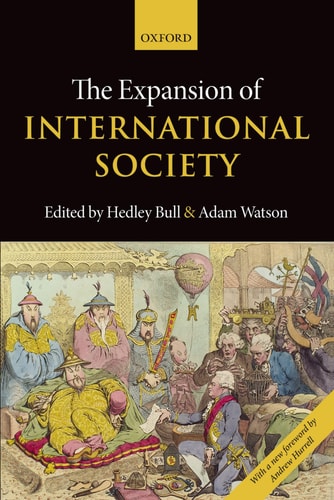
The Expansion of International Society
0
0
As an Amazon Associate and affiliate partner, Menrva Books earns from qualifying purchases. Learn more
Author Description
Product Description This book is a systematic investigation of the origins and nature of the international society of today. The work of a study group of distinguished scholars, it examines comprehensively the expansion of the international society of European states across the rest of the globe, and its subsequent transformation from a society fashioned in Europe and dominated by Europeans into today's global international society of nearly two hundred states, the great majority of which are not European.The first section describes the predominance of the European system in a floodtide of expansion from the sixteenth century onwards, which united the whole world for the first time in a single economic, strategic, and political unit. The process whereby non-European states came to take their place as members of the same society, accepting its rules and institutions, is the subject of the second part; and the third section examines the repudiation of European, Russian, and American domination by states and peoples of the Third World and the consequent movement away from a system based on European hegemony. The last part is concerning with the new international order that has emerged from the ebb tide of European dominance, and focuses on a central question. Has the geographical expansion of international society led to a contradiction of the consensus about common interests, rules, and institutions on which an international society proper must rest? Or can we say that the old Europeansystem has been modified and developed in such a way that a new, genuinely universal, and non-hegemonial structure for international relations has taken root?A new foreword by Andrew Hurrell examines the impact of this seminal work and sets its continued contribution in context. About the Author Hedley Bull was Montague Burton Professor of International Relations at Oxford University.Adam Watson was Visiting Professor at the Center for Advanced Studies, University of Virginia, and former
Menrva's Summary
THE THESIS
This book investigates whether the global expansion of the European international system has resulted in a coherent, universal structure of shared rules or a fragmented order defined by the decline of Western hegemony. The authors, both eminent scholars in the field of international relations, utilize a collaborative framework to analyze the historical transition from a Eurocentric system to a contemporary global society. By examining the integration of non-European states into established diplomatic institutions, the text evaluates the viability of a non-hegemonial international order in the modern era.
THE SCOPE MAP
What You Will Find
- Historical analysis of the sixteenth-century European expansion and its impact on global strategic and economic unity.
- Examination of the process by which non-European states adopted and adapted to Western diplomatic rules and institutions.
- Critical assessment of the Third World's repudiation of European, Russian, and American dominance.
- Theoretical inquiry into the future of international consensus regarding common interests and institutional stability.
THE AUTHORITY PERSPECTIVE
Experts and scholars of international relations recognize this work as a foundational text for understanding the evolution of global political structures. Readers frequently note the academic density of the prose, which provides a rigorous historical and theoretical framework for analyzing contemporary state relations.
Page Count:
490
Publication Date:
2026-02-28
Publisher:
Oxford University Press
ISBN-10:
0198716869
ISBN-13:
9780198716860
History
Diplomacy
International relations
Global Studies
Community Tags
Other Editions(2)
Similar Books









Reader Comments
Share Your Thoughts
No comments yet. Be the first to share your thoughts!