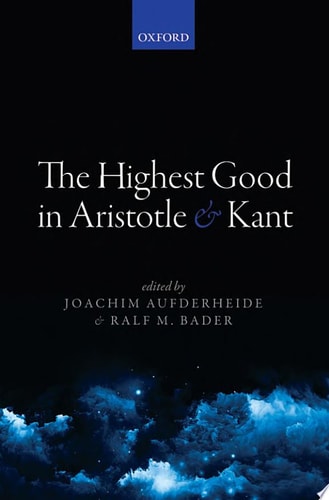
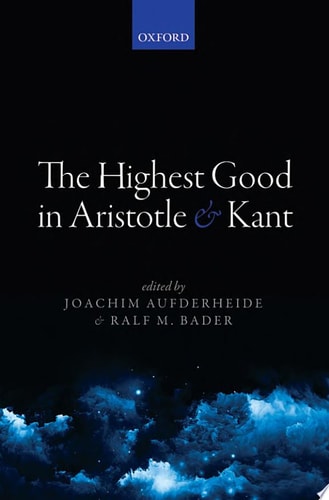
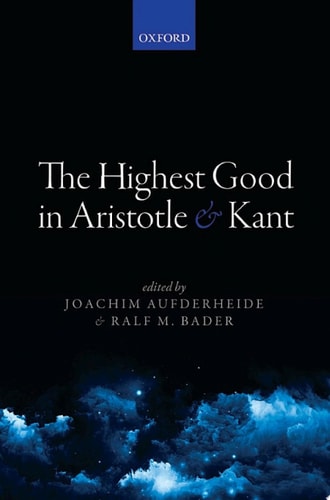
The Highest Good in Aristotle and Kant
0
0
As an Amazon Associate and affiliate partner, Menrva Books earns from qualifying purchases. Learn more
Author Description
The notion of the highest good used to occupy a primary role in ethical theorising, but has largely disappeared from the contemporary landscape. The notion was central to both Aristotle's and Kant's ethical theories, however--a surprising observation given that their approaches to ethics are commonly conceived as being diametrically opposed. The essays in this collection provide a comprehensive treatment of the highest good in Aristotle and Kant and show that, even though there are important differences in terms of content, there are also important similarities in terms of the structural features of Aristotle's and Kant's value theories. By carefully analysing Aristotle's and Kant's theories of the highest good, a team of experts in the field shed light on their respective ethical theories and highlight the richness, complexity, and fruitfulness of the notion of the highest good.
Menrva's Summary
THE THESIS
This collection investigates the structural similarities and conceptual differences between the highest good as defined in the ethical frameworks of Aristotle and Kant. The editors, Joachim Aufderheide and Ralf M. Bader, curate a series of scholarly essays that challenge the common perception of these two philosophers as diametrically opposed. By examining the role of the highest good in both systems, the contributors provide a rigorous analysis of how these thinkers conceptualized value and moral ends.
THE SCOPE MAP
What You Will Find
- Comparative analysis of Aristotelian and Kantian value theories
- Examination of the structural role of the highest good in ethical systems
- Scholarly essays from experts in the field of moral philosophy
- Critical evaluation of the historical decline of the highest good in contemporary ethics
THE AUTHORITY PERSPECTIVE
Experts identify this volume as a significant contribution to the study of classical and modern ethics. Readers frequently note the academic density of the prose, making it a specialized resource for students and scholars of moral philosophy.
Page Count:
264
Publication Date:
2015-07-01
Publisher:
Oxford University Press
ISBN-10:
0198714017
ISBN-13:
9780198714019
Philosophy
Ethics
Aristotle
Academic
Community Tags
Other Editions(4)
Similar Books