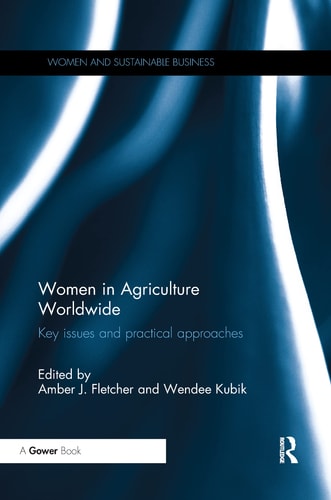
Women in Agriculture Worldwide: Key Issues and Practical Approaches
0
0
As an Amazon Associate and affiliate partner, Menrva Books earns from qualifying purchases. Learn more
Author Description
Over the past two decades, existing documentation of women in the agricultural sector has surveyed topics such as agricultural restructuring and land reform, international trade agreements and food trade, land ownership and rural development and rural feminisms. Many studies have focused on either the high-income countries of the global North or the low-income countries of the global South. This separation suggests that the North has little to learn from the South, or that there is little shared commonality across the global dividing line. Fletcher and Kubik cross this political, economic, and ideological division by drawing together authors from 5 continents. They discuss the situation for women in agriculture in 13 countries worldwide, with two chapters that cover international contexts. The authors blur the boundaries between academic and organizational authors and their contributors include university-based researchers, gender experts, development consultants, and staff of agricultural research centers and international organizations (i.e., Oxfam, the United Nations World Food Program). The common thread connecting these diverse authors is an emphasis on practical and concrete solutions to address the challenges, such as lack of access to resources and infrastructure, lack of household decision-making power, and gender biases in policymaking and leadership, still faced by women in agriculture around the world. Ongoing issues in climate change will exacerbate many of these issues and several chapters also address environment and sustainability. This book is of great interest to readers in the areas of gender studies, agriculture, policy studies, environmental studies, development and international studies.
Menrva's Summary
THE THESIS
This book investigates the multifaceted challenges and practical solutions for women in agriculture across diverse global contexts. It addresses the persistent issues of limited access to resources, inadequate infrastructure, restricted household decision-making power, and gender biases in policy and leadership, while also considering the exacerbating effects of climate change and environmental sustainability. The work synthesizes contributions from academics, gender experts, development consultants, and international organization staff, blurring the lines between theoretical research and practical application.
THE SCOPE MAP
- Analysis of the situation for women in agriculture in 13 countries worldwide.
- Discussion of international contexts related to women in agriculture.
- Exploration of practical and concrete solutions to address challenges faced by women in agriculture.
- Examination of issues related to lack of access to resources and infrastructure.
- Investigation into the lack of household decision-making power for women.
- Analysis of gender biases in policymaking and leadership within the agricultural sector.
- Consideration of ongoing issues in climate change and their impact on women in agriculture.
- Chapters addressing environment and sustainability in relation to women's roles.
THE AUTHORITY PERSPECTIVE
This collection draws together diverse voices from multiple continents, aiming to bridge the perceived divide between high-income and low-income countries regarding women in agriculture. The emphasis on practical solutions and concrete approaches suggests a focus on actionable insights for policymakers, researchers, and practitioners. The inclusion of contributors from both academic and organizational backgrounds indicates a blend of theoretical grounding and real-world application, promising a comprehensive overview of current issues and potential interventions.
Page Count:
276
Publication Date:
2020-06-30
Publisher:
Taylor & Francis Group
ISBN-10:
0367605317
ISBN-13:
9780367605315
Non-Fiction
History
Economics
Policy Studies
Gender Studies
Agriculture
Community Tags
Similar Books