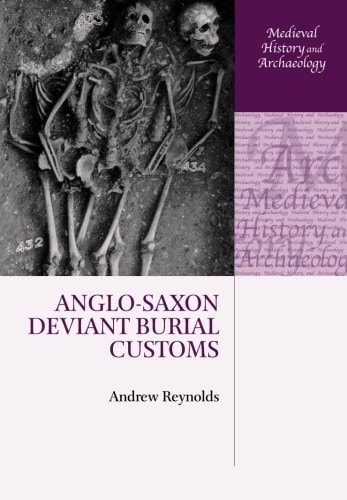
Anglo-Saxon Deviant Burial Customs: Medieval History and Archaeology
0
0
As an Amazon Associate and affiliate partner, Menrva Books earns from qualifying purchases. Learn more
Author Description
Anglo-Saxon Deviant Burial Customs is the first detailed consideration of the ways in which Anglo-Saxon society dealt with social outcasts. Beginning with the period following Roman rule and ending in the century following the Norman Conquest, it surveys a period of fundamental social change, which included the conversion to Christianity, the emergence of the late Saxon state, and the development of the landscape of the Domesday Book.While an impressive body of written evidence for the period survives in the form of charters and law-codes, archaeology is uniquely placed to investigate the earliest period of post-Roman society - the fifth to seventh centuries - for which documents are lacking. For later centuries, archaeological evidence can provide us with an independent assessment of the realities of capital punishment and the status of outcasts.Andrew Reynolds argues that outcast burials show a clear pattern of development in this period. In the pre-Christian centuries, 'deviant' burial remains are found only in community cemeteries, but the growth of kingship and the consolidation of territories during the seventh century witnessed the emergence of capital punishment and places of execution in the English landscape. Locally determined rites, such as crossroads burial, now existed alongside more formal execution cemeteries. Gallows were located on major boundaries, often next to highways, always in highly visible places.The findings of this pioneering national study thus have important consequences on our understanding of Anglo-Saxon society. Overall, Reynolds concludes, organized judicial behaviour was a feature of the earliest Anglo-Saxon kingdoms, rather than just the two centuries prior to the Norman Conquest.
Menrva's Summary
THE THESIS
This study investigates the evolution of social exclusion and judicial punishment in Anglo-Saxon England through the analysis of deviant burial practices. Andrew Reynolds, a specialist in medieval archaeology, synthesizes archaeological data with historical law codes to track how societies managed outcasts from the post-Roman period through the Norman Conquest. He argues that the formalization of capital punishment and the establishment of execution sites were integral to the development of early Anglo-Saxon kingship and territorial consolidation.
THE SCOPE MAP
What You Will Find
- Archaeological analysis of burial sites from the fifth to the eleventh centuries.
- Examination of legal codes and charters regarding social outcasts.
- Mapping of execution sites, gallows, and crossroads burials within the landscape.
- Evidence of the transition from community-based rites to state-sanctioned judicial punishment.
THE AUTHORITY PERSPECTIVE
Experts recognize this work as a foundational text for understanding the intersection of landscape archaeology and early medieval legal history. Scholars frequently cite the book for its systematic approach to interpreting non-normative burial remains as indicators of state development.
Page Count:
340
Publication Date:
2014-12-02
Publisher:
Oxford University Press
ISBN-10:
0198723156
ISBN-13:
9780198723158
History
Social change
Burial
Anthropology
Great Britain
Archaeology
Sociology
Anglo-Saxons
Community Tags
Similar Books