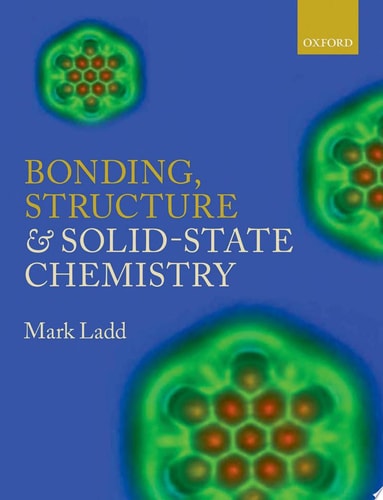
Bonding, Structure and Solid-State Chemistry
Author Description
This book provides a study in Bonding, Structure and Solid State Chemistry. It is based on lecture courses given over several years, but is not directed at any particular degree course. Thus, it will find a place in all years of first-degree courses in both chemistry and those subjects for which chemistry forms a significant part. It will also prepare readers for more intensive study in the title topics. Pre-knowledge is assumed in mathematics and physical sciences at about final year high school level. Additional mathematical and other topics are presented where necessary as appendices, so as not to disturb the flow of the main text. The book is copiously illustrated, including many stereoscopic diagrams (with practical advice on correct viewing) and colour illustrations. A suite of computer programs, some of which are interactive, has been devised for the book and is available on-line from the publisher's website, global.oup.com/booksites/content/9780199670888. They are available for both 32- and 64-bit operating systems, and are easily executed on a PC or laptop; notes on their applications are provided. Problems have been devised for each chapter and fully worked 'tutorial'; solutions are included. After an introductory chapter, the book presents a study based on the main interactive forces responsible for cohesion in the solid state of matter. No classification is without some ambiguity, but that chosen allows for a structured discussion over a wide range of compounds. Each chapter includes worked examples on the study topics which, together with the problems provided, should ensure a thorough understanding of the textual material.
Menrva's Summary
THE THESIS
This text investigates the fundamental principles of bonding, atomic structure, and the cohesive forces that dictate the properties of solid-state matter. Mark Ladd, drawing on years of academic lecture experience, provides a comprehensive framework for understanding chemical structures without tethering the material to a specific degree program. The book assumes a foundational knowledge of mathematics and physical sciences equivalent to final-year high school curricula, utilizing appendices to introduce advanced concepts without disrupting the primary narrative flow. By categorizing matter based on interactive forces, the author facilitates a structured analysis of a wide range of chemical compounds.
THE SCOPE MAP
What You Will Find
- Comprehensive study of bonding types and their influence on solid-state cohesion.
- Integration of stereoscopic diagrams and color illustrations to visualize complex molecular geometries.
- A suite of interactive computer programs designed to simulate chemical structures and properties.
- Extensive pedagogical support including chapter-specific problems and fully worked tutorial solutions.
THE AUTHORITY PERSPECTIVE
Experts and educators frequently cite this work as a versatile resource suitable for undergraduate chemistry students across various levels of study. Readers often note the utility of the included computer programs and worked examples in reinforcing the theoretical concepts presented in the text.
Page Count:
448
Publication Date:
2016-05-10
Publisher:
Oxford University Press
ISBN-10:
0198729944
ISBN-13:
9780198729945
Science
Earth Sciences
Chemistry
Physical Chemistry
textbook
Solid state chemistry
Community Tags
Similar Books