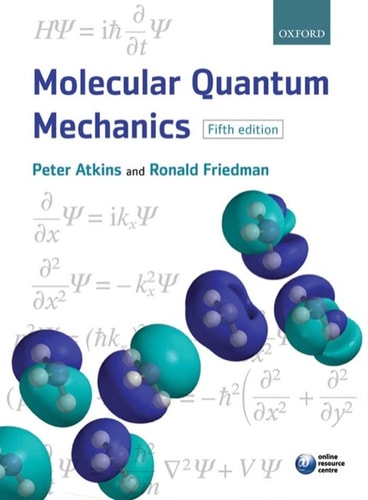
Molecular Quantum Mechanics
0
0
As an Amazon Associate and affiliate partner, Menrva Books earns from qualifying purchases. Learn more
Author Description
Quantum mechanics embraces the behaviour of all known forms of matter, including the atoms and molecules from which we, and all living organisms, are composed. Molecular Quantum Mechanics leads us through this absorbing yet challenging subject, exploring the fundamental physical principles that explain how all matter behaves. With the clarity of exposition and extensive learning features that have established the book as a leading text in the field, Molecular Quantum Mechanics takes us from the foundations of quantum mechanics, through quantum models of atomic, molecular, and electronic structure, and on to discussions of spectroscopy, and the electronic and magnetic properties of molecules. Lucid explanations and illuminating artworks help to visualise the many abstract concepts upon which the subject is built. Fully updated to reflect the latest advances in computational techniques, and enhanced with more mathematical support and worked examples than ever before, Molecular Quantum Mechanics remains the ultimate resource for those wishing to master this important subject. Online Resource Centre For students: Interactive worksheets to help students master mathematical concepts through hands-on learning Solutions to selected exercises and problems For registered adopters of the book: Figures in electronic format Solutions to all exercises and problems
Menrva's Summary
THE THESIS
This text investigates the fundamental physical principles of quantum mechanics as they apply to the behavior of atoms and molecules. Authors Peter W. Atkins and Ronald S. Friedman, both established figures in chemical education, provide a rigorous framework that bridges basic quantum theory with complex molecular applications. The book utilizes a structured pedagogical approach, integrating mathematical derivations with conceptual explanations to guide students through the complexities of electronic structure and molecular properties.
THE SCOPE MAP
What You Will Find
- Foundations of quantum theory and wave mechanics
- Models of atomic, molecular, and electronic structure
- Analysis of spectroscopy and magnetic properties of molecules
- Computational techniques and mathematical support
- Worked examples and interactive learning worksheets
Scope Limits
- Does not cover advanced quantum field theory or high-energy particle physics
- Does not provide an exhaustive history of quantum development
THE AUTHORITY PERSPECTIVE
Experts and educators frequently cite this work as a foundational text for undergraduate and graduate chemistry students due to its clear exposition of abstract concepts. Readers often note the high level of mathematical density, which requires a solid background in calculus and linear algebra to fully utilize the provided examples.
Page Count:
592
Publication Date:
2010-01-01
Publisher:
OUP Oxford
ISBN-10:
0191007668
ISBN-13:
9780191007668
Science
Chemistry
textbook
Molecular Physics
Physical Chemistry
Earth Sciences
Physics