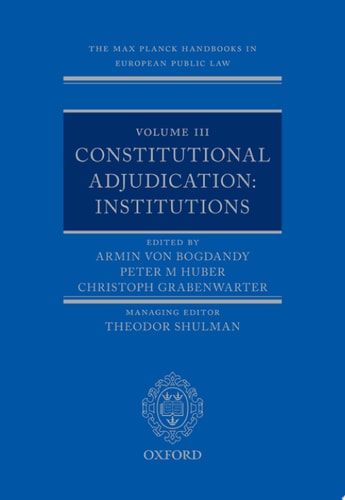
The Max Planck Handbooks in European Public Law: Volume III: Constitutional Adjudication: Institutions
0
0
As an Amazon Associate and affiliate partner, Menrva Books earns from qualifying purchases. Learn more
Author Description
The Max Planck Handbooks in European Public Law describe and analyse public law of the European legal space, an area that encompasses not only the law of the European Union but also the European Convention on Human Rights and, importantly, the domestic public laws of European states. Recognizing that the ongoing vertical and horizontal processes of European integration make legal comparison the task of our time for both scholars and practitioners, the series aims to foster the development of a specifically European legal pluralism and to contribute to the legitimacy and efficiency of European public law.The first volume of the series began this enterprise with an appraisal of the evolution of the state and its administration, offering both cross-cutting contributions and specific country reports. The third volume (the second in chronological terms) continues this approach with an in-depth appraisal of constitutional adjudication in various and diverse European countries. Fourteen country reports and two cross-cutting contributions investigate the antecedents, foundations, organization, procedure, and outlook of constitutional adjudicators throughout the Continent. They include countries with powerful constitutional courts, jurisdictions with traditional supreme courts, and states with small institutions and limited ex ante review. In keeping with the focus on a diverse but unified legal space, each report also details how its institution fits into the broader association of constitutional courts that, through dialogue and conflict, brings to fruition the European legal space. Together, the chapters of this volume provide a strong and diverse foundation for this dialogue to flourish.
Menrva's Summary
THE THESIS
This volume investigates the structural and procedural diversity of constitutional adjudication institutions across the European legal space. Edited by Armin von Bogdandy, Christoph Grabenwarter, and Peter M. Huber, the text synthesizes comparative legal analysis to understand how various national courts contribute to the broader European legal order. The authors argue that legal comparison is essential for fostering European legal pluralism and enhancing the legitimacy of public law systems.
THE SCOPE MAP
What You Will Find
- Comparative analysis of fourteen distinct European constitutional adjudication systems.
- Examination of institutional antecedents, organizational structures, and procedural frameworks.
- Case studies covering both powerful constitutional courts and traditional supreme court models.
- Cross-cutting contributions exploring the dialogue between national institutions and the European legal space.
THE AUTHORITY PERSPECTIVE
Experts identify this series as a foundational resource for scholars and practitioners navigating the complexities of European public law. Readers frequently note the academic density of the prose and the rigorous, systematic approach to comparative jurisprudence.
Page Count:
976
Publication Date:
2020-05-12
Publisher:
Oxford University Press
ISBN-10:
0198726414
ISBN-13:
9780198726418
Law
European Law
Constitutional Law
Reference
Community Tags
Other Editions(2)

Similar Books











Reader Comments
Share Your Thoughts
No comments yet. Be the first to share your thoughts!