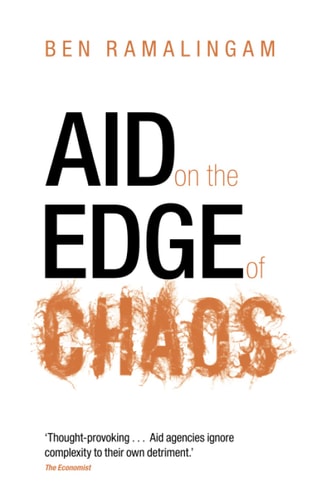
Aid on the Edge of Chaos: Rethinking International Cooperation in a Complex World
0
0
As an Amazon Associate and affiliate partner, Menrva Books earns from qualifying purchases. Learn more
Author Description
Many agree that the foreign aid system - which today involves virtually every nation on earth - needs drastic change. But there is much conflict as to what should be done. In Aid on the Edge of Chaos, Ben Ramalingam argues that what is most needed is the creative and innovative transformation of how aid works.Foreign aid today is dominated by linear, mechanistic ideas that emerged from early twentieth century industry, and are ill-suited to the world we face today.The problems and systems aid agencies deal with on a daily basis have more in common with ecosystems than machines: they are interconnected, diverse, and dynamic; they cannot be just simply re-engineered or fixed.Outside of aid, social scientists, economists, business leaders, and policy makers have started applying innovative and scientific approaches to such problems, informed by ideas from the 'new science' of complex adaptive systems. Inspired by these efforts, aid practitioners and researchers have started experimenting with such approaches in their own work.This book showcases the experiences, insights, and often remarkable results of innovative thinkers and practitioners who are working to bring these approaches into the mainstream of aid. From transforming child malnutrition to rethinking economic growth, from building peace to reversing desertification, from rural Vietnam to urban Kenya, the ideas of complex systems thinking are starting to be used to make foreign aid more relevant, more appropriate, and more catalytic.Aid on the Edge of Chaos argues that such ideas and approaches should play a vital part of the transformation of aid. Aid should move from being an imperfect post-World War II global resource transfer system, to a new form of global cooperation that is truly fit for the twenty-first century.
Menrva's Summary
THE THESIS
This book investigates whether the application of complex adaptive systems theory can transform the current, outdated foreign aid model into a more effective framework for global cooperation. Ben Ramalingam, a researcher and practitioner in international development, critiques the reliance on linear, mechanistic management styles inherited from twentieth-century industrial models. He argues that because global development challenges function more like dynamic ecosystems than machines, they require a shift toward innovative, adaptive strategies that embrace complexity rather than attempting to control it through rigid planning.
THE SCOPE MAP
What You Will Find
- Analysis of complex adaptive systems theory applied to international development.
- Case studies ranging from child malnutrition programs to peace-building initiatives.
- Comparative research across diverse geographic locations including Vietnam and Kenya.
- Methodologies for transitioning from resource-transfer systems to catalytic global cooperation.
THE AUTHORITY PERSPECTIVE
Experts and practitioners in the development sector frequently cite this work as a foundational text for understanding the shift toward complexity-informed policy. Readers often note the book's ability to bridge the gap between abstract systems theory and the practical, on-the-ground realities of humanitarian aid work.
Page Count:
480
Publication Date:
2015-04-16
Publisher:
Oxford University Press
ISBN-10:
0198728247
ISBN-13:
9780198728245
Economics
International relations
Systems Thinking
Social Science
Community Tags
Other Editions(3)

Similar Books



Reader Comments
Share Your Thoughts
No comments yet. Be the first to share your thoughts!