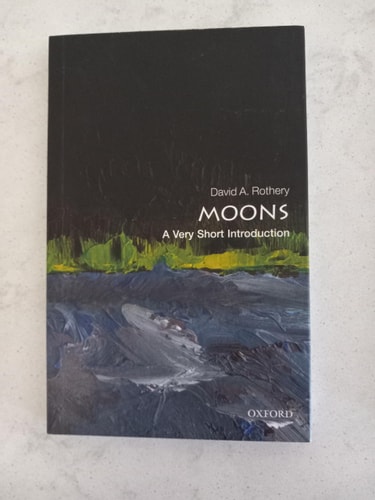
Moons: A Very Short Introduction
0
0
As an Amazon Associate and affiliate partner, Menrva Books earns from qualifying purchases. Learn more
Author Description
Proving to be both varied and fascinating, moons are far more common than planets in our Solar System. Our own Moon has had a profound influence on Earth, not only through tidal effects, but even on the behaviour of some marine animals. Many remarkable things have been discovered about the moons of the giant outer planets from Voyager, Galileo, Cassini, and other spacecraft. Scientists have glimpsed volcanic activity on Io, found oceans of water on Titan, and captured photos of icy geysers bursting from Enceladus. It looks likely that microbial life beyond the Earth may be discovered on a moon rather than a planet.In this Very Short Introduction David Rothery introduces the reader to the moons of our Solar System, beginning with the early discoveries of Galileo and others, describing their variety of mostly mythological names, and the early use of Jupiter's moons to establish position at sea and to estimate the speed of light. Rothery discusses the structure, formation, and influence of our Moon, and those of the other planets, and ends with the recent discovery of moons orbiting asteroids, whilst looking forward to the possibility of finding moons of exoplanets in planetary systems far beyond our own.ABOUT THE SERIES:The Very Short Introductions series from Oxford University Press contains hundreds of titles in almost every subject area. These pocket-sized books are the perfect way to get ahead in a new subject quickly. Our expert authors combine facts, analysis, perspective, new ideas, and enthusiasm to make interesting and challenging topics highly readable.
Menrva's Summary
THE THESIS
This book investigates the diverse physical characteristics, origins, and scientific significance of moons within our Solar System and beyond. David Rothery, a professor of planetary geosciences, utilizes data from major space missions like Voyager, Galileo, and Cassini to construct a comprehensive overview of lunar bodies. He argues that moons are not merely secondary satellites but are central to understanding planetary formation, tidal mechanics, and the potential for extraterrestrial life.
THE SCOPE MAP
What You Will Find
- Historical context regarding early lunar observations by Galileo and others.
- Analysis of the structural and geological diversity of moons, including volcanic activity and subsurface oceans.
- Exploration of the influence of Earth's Moon on terrestrial tides and biological rhythms.
- Discussion on the potential for discovering microbial life on moons orbiting giant outer planets.
- Examination of moons orbiting asteroids and the search for exomoons in distant solar systems.
THE AUTHORITY PERSPECTIVE
Experts and readers recognize this text as a highly accessible entry point into planetary science, praised for its ability to distill complex astronomical data into a concise format. The prose is noted for its clarity, making it a standard recommendation for students and enthusiasts seeking a foundational understanding of lunar bodies.
Page Count:
144
Publication Date:
2016-01-01
Publisher:
Oxford University Press
ISBN-10:
0198735278
ISBN-13:
9780198735274
Science
Non-Fiction
Planetary Science
Satellites
Astronomy
Space
Community Tags
Similar Books