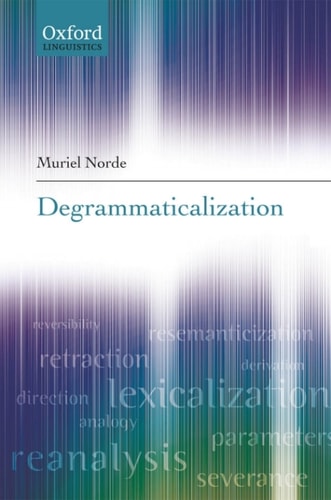
Degrammaticalization
0
0
As an Amazon Associate and affiliate partner, Menrva Books earns from qualifying purchases. Learn more
Author Description
Grammaticalization is a well-attested process of linguistic change in which a lexical item becomes a function word, which may be further reduced to a clitic or affix. Proponents of the universality of grammaticalization have usually argued that it is unidirectional and have thus found it a useful tool in linguistic reconstruction. In this book Prof Norde shows that change is reversible on all levels: semantic, morphological, syntactic, and phonological. As a consequence, the alleged unidirectionality of grammaticalization is not a reliable reconstructional tool, even if degrammaticalization is a rare phenomenon. Degrammaticalization, she argues, is essentially different from grammaticalization: it usually comprises a single change, examples being shifts from affix to clitic, or from function word to lexical item. And where grammaticalization can be seen as a process, degrammaticalization is often the by-product of other changes. Nevertheless, she shows that it can be described, like grammaticalization, in a principled way, in order to establish whether a change in a word has been from more to less grammatical or vice versa, and the stages by which it has become so. Using data from different languages she constructs a typology of degrammaticalization changes. She explains why degrammaticalization is so rare and why some linguists have such strongly negative feelings about the possibility of its existence. She adds to the understanding of grammaticalization and makes a significant contribution to methods of linguistic reconstruction and the study of language change. She writes clearly, aiming to be understood by advanced undergraduate students as well as appealing to scholars and graduate researchers in historical linguistics.
Menrva's Summary
THE THESIS
This book investigates whether the process of grammaticalization is truly unidirectional or if linguistic change can be reversed through the process of degrammaticalization. Muriel Norde, a specialist in historical linguistics, challenges the long-held assumption that lexical items only move toward increased grammatical function. By analyzing shifts across semantic, morphological, syntactic, and phonological levels, she argues that while rare, degrammaticalization exists as a distinct phenomenon that requires a principled descriptive framework.
THE SCOPE MAP
What You Will Find
- A comprehensive typology of degrammaticalization changes across various languages.
- Analysis of shifts from affixes to clitics and function words to lexical items.
- A theoretical framework for distinguishing between increased and decreased grammaticalization.
Scope Limits
- The text does not provide an exhaustive dictionary of all degrammaticalization instances in every language family.
- It does not focus on sociolinguistic factors, prioritizing structural and historical linguistic analysis instead.
THE AUTHORITY PERSPECTIVE
Experts in historical linguistics recognize this work as a significant challenge to the traditional unidirectionality hypothesis in language change. Readers frequently note the academic density of the prose, which is tailored for advanced undergraduates and professional researchers in the field.
Page Count:
256
Publication Date:
2009-01-01
Publisher:
Oxford University Press
ISBN-10:
0191548936
ISBN-13:
9780191548932
Historical linguistics
English
Linguistics
Grammar
English & College Success
Academic
Community Tags
Other Editions(3)
Similar Books




Reader Comments
Share Your Thoughts
No comments yet. Be the first to share your thoughts!