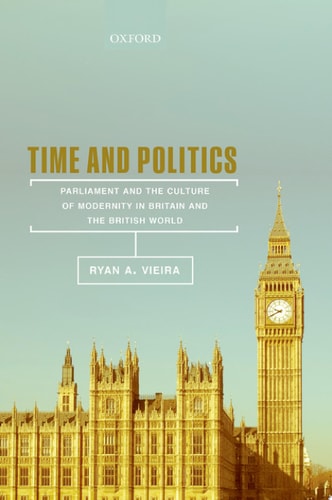
Time and Politics: Parliament and the Culture of Modernity in Nineteenth-Century Britain and the British World
0
0
As an Amazon Associate and affiliate partner, Menrva Books earns from qualifying purchases. Learn more
Author Description
Time and Politics is the first cultural and transnational history of modern procedural reform in the Westminster parliamentary system. The study centres on the nineteenth-century emergence of a desire to modernise and make more efficient the procedural rules of parliamentary law-making. Contrary to existing interpretations, which see this as a product of transformations in political structure and practice, this volume demonstrates how the evolution of Parliament's rules was structured by transformations within the wider culture of time. Ryan Vieira argues that the spread of an increasingly rigorous time discipline in concert with a growing consciousness of being modern worked to progressively erode the legitimacy of the historically developed rules of parliamentary debate and law-making, while simultaneously implanting new ways of judging the effectiveness of parliamentary institutions. By the 1880s, this process had transformed efficiency into the ultimate criteria of parliamentary effectiveness.Using the conceptual framework of the British world, Time and Politics demonstrates how this new understanding of parliamentary effectiveness was exported to the colonies of settlement through a series of communicative networks and provided colonial parliamentarians with the ability to imagine the inefficiencies of their own legislatures as part of a larger transnational problem. In making these arguments, this volume lays the groundwork for a new type of parliamentary history.
Menrva's Summary
THE THESIS
This study investigates how the evolution of procedural rules within the nineteenth-century Westminster parliamentary system was fundamentally shaped by shifting cultural perceptions of time and modernity. Ryan A. Vieira, a scholar of British political history, utilizes a transnational framework to argue that the transition toward parliamentary efficiency was not merely a structural change, but a consequence of a broader societal adoption of rigorous time discipline. By examining the interplay between parliamentary law-making and the emerging consciousness of modernity, the author demonstrates how efficiency became the primary metric for institutional legitimacy by the 1880s.
THE SCOPE MAP
What You Will Find
- A cultural and transnational history of procedural reform in the Westminster parliamentary system.
- An analysis of how time discipline and the concept of modernity influenced legislative rules.
- A study of the export of parliamentary efficiency standards to British colonies of settlement.
- An examination of communicative networks that linked colonial legislatures to the British parliamentary model.
THE AUTHORITY PERSPECTIVE
Historians and political scientists recognize this work as a significant contribution to the study of parliamentary history, particularly for its focus on the intersection of temporal culture and legislative practice. Scholars frequently note the depth of the author's transnational research and the novelty of his argument regarding the cultural origins of procedural efficiency.
Page Count:
240
Publication Date:
2015-09-09
Publisher:
Oxford University Press
ISBN-10:
0198737548
ISBN-13:
9780198737544
History
Great Britain
Cultural History
Parliamentary Studies
Representative government and representation
British History
Community Tags
Similar Books