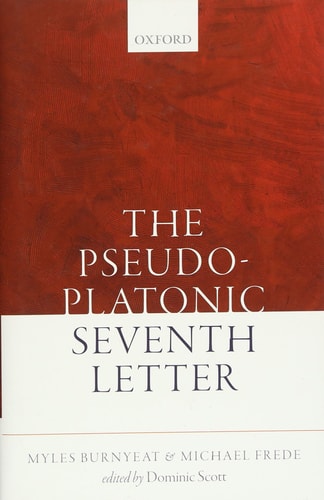
The Pseudo-Platonic Seventh Letter
0
0
As an Amazon Associate and affiliate partner, Menrva Books earns from qualifying purchases. Learn more
Author Description
The Seventh Platonic Letter describes Plato's attempts to turn the ruler of Sicily, Dionysius II, into a philosopher ruler along the lines of the Republic. It explains why Plato turned from politics to philosophy in his youth and how he then tried to apply his ideas to actual politics later on. It also sets out his views about language, writing and philosophy. As such, it represents a potentially crucial source of information about Plato, who tells us almost nothing about himself in his dialogues. But is it genuine? Scholars have debated the issue for centuries, although recent opinion has moved in its favour. The origin of this book was a seminar given in Oxford in 2001 by Myles Burnyeat and Michael Frede, two of the most eminent scholars of ancient philosophy in recent decades. Michael Frede begins by casting doubt on the Letter by looking at it from the general perspective of letter writing in antiquity, when it was quite normal to fabricate letters by famous figures from the past. Both then attack the authenticity of the letter head-on by showing how its philosophical content conflicts with what we find in the Platonic dialogues. They also reflect on the question of why the Letter was written, whether as an attempt to exculpate Plato from the charge of meddling in politics (Frede), or as an attempt to portray, through literary means, the ways in which human weakness and emotions can lead to disasters in political life (Burnyeat).
Menrva's Summary
THE THESIS
This work investigates the authenticity of the Seventh Letter, a document traditionally attributed to Plato, by analyzing its philosophical consistency and historical context. The authors, Michael Frede and Myles Burnyeat, utilize their expertise in ancient philosophy to scrutinize the text against the established Platonic corpus. They argue that the letter's content conflicts with the dialogues, suggesting it may be a later fabrication rather than a genuine autobiographical account.
THE SCOPE MAP
What You Will Find
- A critical analysis of ancient epistolary traditions and the prevalence of pseudepigrapha.
- A comparative study between the Seventh Letter and the known Platonic dialogues.
- Historical examination of Plato's political involvement in Sicily under Dionysius II.
- Interpretive theories regarding the motivations behind the letter's creation, including political exculpation and literary characterization.
THE AUTHORITY PERSPECTIVE
Experts recognize this volume as a significant contribution to the ongoing scholarly debate regarding the Platonic canon. Readers frequently note the rigorous academic density of the prose, which reflects the high level of discourse expected from such prominent philosophers.
Page Count:
208
Publication Date:
2015-08-11
Publisher:
Oxford University Press
ISBN-10:
0198733658
ISBN-13:
9780198733652
Philosophy
Literary Criticism
Ancient History
Plato
Community Tags
Similar Books