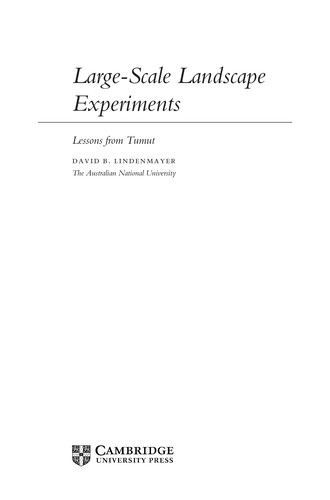
Large-scale landscape experiments
0
0
As an Amazon Associate and affiliate partner, Menrva Books earns from qualifying purchases. Learn more
Author Description
The Tumut Fragmentation and yielded extensive data on changes in both plant and animal populations in areas of native forest and pine plantation. It is unique in the way that many different factors and processes influencing a wide range of species groups have been studied in the one large-scale natural experiment. Writing for academic researchers, professionals and graduate students, David B. Lindenmayer uses the Study and other relevant research to provide an overview of the relationships between landscape change, habitat fragmentation, and biodiversity conservation. He details the background ecology of landscape change and habitat fragmentation, the experimental design underpinning the establishment of the large-scale natural experiment, and the implementation of, and results from, an array of key and strongly contrasting research programs over the past 15 years. Key lessons are drawn on throughout the book on the design and implementation of large-scale ecological studies, biodiversity conservation in fragmented landscapes, and the management of plantation landscapes for enhanced nature conservation. The book highlights how important new insights can be generated from integrating demographic, genetic, and modeling research."--Jacket.
Menrva's Summary
THE THESIS
This book investigates the complex interplay between landscape change, habitat fragmentation, and biodiversity conservation through the lens of large-scale ecological experiments. David B. Lindenmayer, drawing on extensive data from the Tumut Fragmentation Study and other research, provides a comprehensive overview for academics, professionals, and graduate students. The book details the ecological background of landscape change, the experimental design of natural experiments, and the results from fifteen years of research programs. It offers key lessons on designing and implementing large-scale ecological studies, conserving biodiversity in fragmented landscapes, and managing plantation landscapes for conservation.
THE SCOPE MAP
- Detailed background ecology of landscape change and habitat fragmentation.
- The experimental design underpinning the large-scale natural experiment.
- Implementation and results from key research programs over 15 years.
- Integration of demographic, genetic, and modeling research for new insights.
- Key lessons on designing and implementing large-scale ecological studies.
- Biodiversity conservation strategies in fragmented landscapes.
- Management of plantation landscapes for enhanced nature conservation.
THE AUTHORITY PERSPECTIVE
The book is written for academic researchers, professionals, and graduate students, offering an overview of landscape change, habitat fragmentation, and biodiversity conservation. It highlights the importance of integrating demographic, genetic, and modeling research to generate new insights. The work details the experimental design and results from extensive studies, providing practical lessons for ecological research and conservation management. Its focus on large-scale natural experiments makes it a valuable resource for understanding complex ecological relationships.
Page Count:
287
Publication Date:
2009-01-01
ISBN-10:
0521881560
ISBN-13:
9780521881562
Science
Psychology
Non-Fiction
Conservation Biology
Biodiversity
Landscape Ecology
Forestry
Ecology
Research Methods
Community Tags
Similar Books