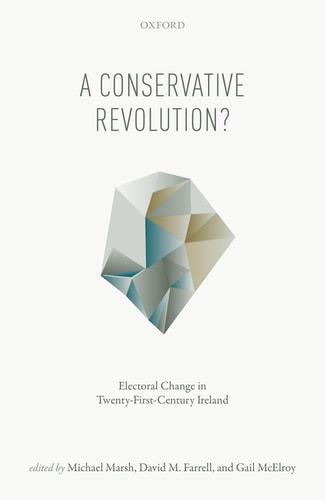
A Conservative Revolution?: Electoral Change in Twenty-First Century Ireland
0
0
As an Amazon Associate and affiliate partner, Menrva Books earns from qualifying purchases. Learn more
Author Description
The 2011 general election in the Republic of Ireland, which took place against a backdrop of economic collapse, was one of the most dramatic ever witnessed. The most notable outcome was the collapse of Fianna Fail, one of the world's most enduring and successful parties. In comparative terms Fianna Fail's defeat was among the largest experienced by a major party in the history of parliamentary democracy. It went from being the largest party in the state (a position it had held since 1932) to being a bit player in Irish political life. And yet ultimately, there was much that remained the same, perhaps most distinctly of all the fact that no new parties emerged. It was, if anything, a 'conservative revolution'.A Conservative Revolution? examines underlying voter attitudes in the period 2002-11. Drawing on three national election studies the book follows party system evolution and voter behaviour from boom to bust. These data permits an unprecedented insight into a party system and its voters at a time of great change, as the country went through a period of rapid growth to become one of Europe's wealthiest states in the early twenty-first century to economic meltdown in the midst of the international Great Recession, all of this in the space of a single decade. In the process, this study explores many of the well-established norms and conventional wisdoms of Irish electoral behaviour that make it such an interesting case study for comparison with other industrialized democracies.
Menrva's Summary
THE THESIS
This book investigates whether the 2011 Irish general election represented a fundamental shift in the political landscape or a reinforcement of existing conservative structures. The authors, David M. Farrell, Gail McElroy, and Michael N. Marsh, utilize data from three national election studies to track voter behavior and party system evolution from the economic boom of the early 2000s to the subsequent collapse. By analyzing this decade of volatility, the study challenges conventional wisdom regarding Irish electoral norms and provides a comparative framework for understanding how industrialized democracies respond to severe economic crises.
THE SCOPE MAP
What You Will Find
- Longitudinal analysis of voter attitudes and party system evolution between 2002 and 2011.
- Comparative study of the collapse of Fianna Fail against historical international parliamentary defeats.
- Empirical evidence derived from three distinct national election studies conducted during the period.
- Examination of the paradox between economic meltdown and the lack of new party emergence.
THE AUTHORITY PERSPECTIVE
Experts identify this work as a critical resource for understanding the resilience of the Irish party system during the Great Recession. Readers frequently note the academic rigor and the clarity with which the authors synthesize complex electoral data.
Page Count:
312
Publication Date:
2017-05-09
Publisher:
Oxford University Press
ISBN-10:
019874403X
ISBN-13:
9780198744030
History
Government
Elections
Ireland
Voting
Economics history
Community Tags
Similar Books