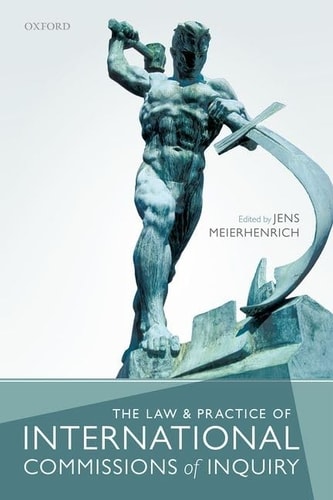
The Law and Practice of International Commissions of Inquiry
0
0
As an Amazon Associate and affiliate partner, Menrva Books earns from qualifying purchases. Learn more
Author Description
This book examines one of the most frequently used - but least understood - forms of humanitarian intervention: international commissions of inquiry (ICOIs). The international community is increasingly dispatching these investigative bodies to conflict zones in an effort to respond to atrocities from civil war to genocide. More than thirty such bodies have been deployed since the end of the Cold War. Because military interventions to save distant strangers are inherently difficult to mount, Jens Meierhenrich finds that legal interventionism is supplanting military interventionism on the international stage.Commonly thought of as fact-finding mechanisms aimed at investigating serious violations of international humanitarian law and human rights law, international commissions of inquiry are created to establish "atrocity facts." They address highly policy-relevant questions: Who is killing whom, and why? Who are the perpetrators? What international crimes, if any, have been committed? Does conflict resolution demand diplomacy, or is coercive force required? International commissions of inquiry are essential for classifying atrocities, attributing responsibility, and recommending further action.This pioneering collection brings together experts in their field to critically assess international fact-finding, from the UN Commission of Experts on the former Yugoslavia, to the the controversial UN Fact-Finding Mission on the Gaza Conflict, as well as the Commission of Inquiry on Human Rights in the Democratic People's Republic of Korea. Essential for scholars and practitioners alike, this highly innovative volume sheds light on the politics, power, and pathologies of this newest interventionism.
Menrva's Summary
THE THESIS
This book investigates the rise of international commissions of inquiry (ICOIs) as a primary mechanism for humanitarian intervention in the post-Cold War era. Jens Meierhenrich, a scholar in the field, analyzes how these investigative bodies have evolved from simple fact-finding tools into instruments of legal interventionism. By examining the deployment of over thirty commissions, the author argues that legal action is increasingly replacing military force as the international community's preferred response to atrocities such as genocide and civil war.
THE SCOPE MAP
What You Will Find
- Analysis of over thirty international commissions of inquiry deployed since the end of the Cold War.
- Examination of the UN Commission of Experts on the former Yugoslavia and the UN Fact-Finding Mission on the Gaza Conflict.
- Case studies regarding the Commission of Inquiry on Human Rights in the Democratic People's Republic of Korea.
- Theoretical framework regarding the politics, power, and pathologies of modern international interventionism.
THE AUTHORITY PERSPECTIVE
Experts identify this volume as a significant contribution to the study of international humanitarian law and the mechanics of global justice. Scholars and practitioners frequently cite the work for its detailed assessment of how investigative bodies influence international policy and conflict resolution.
Page Count:
656
Publication Date:
2024-09-28
Publisher:
Oxford University Press
ISBN-10:
0198743262
ISBN-13:
9780198743262
History
Human rights
International relations
International Law
Public Law
Community Tags
Similar Books