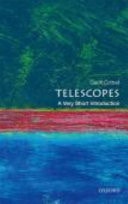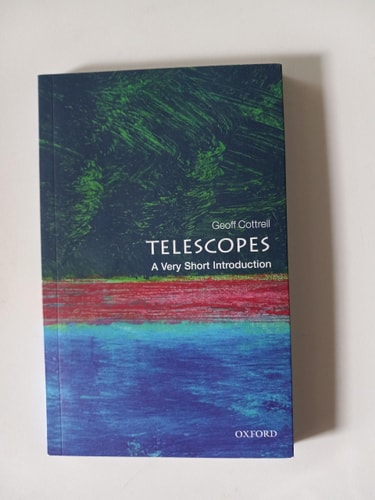
Telescopes: A Very Short Introduction
0
0
As an Amazon Associate and affiliate partner, Menrva Books earns from qualifying purchases. Learn more
Author Description
From the first, telescopes have made dramatic revelations about the Universe and our place in it. Galileo's observations of the Moon's cratered surface and discovery of Jupiter's four big satellites profoundly altered the perception of the heavens. Over the past century, the rapid development of computer technology and sophisticated materials allowed enormous strides in the construction of telescopes. Modern telescopes range from large Earth-based optical telescopes and radio arrays linking up across continents, to space-based telescopes capturing the Universe in infrared, ultraviolet, X-rays, and gamma rays. In combination, they have enabled us to look deep into the Universe and far back in time, capturing phenomena from galactic collisions to the formation of stars and planetary systems, and mapping the faint glow remaining from the Big Bang.In this Very Short Introduction, Geoffrey Cottrell describes the basic physics of telescopes, the challenges of overcoming turbulence and distortion from the Earth's atmosphere, and the special techniques used to capture X-rays and gamma rays in space telescopes. He explains the crucial developments in detectors and spectrographs that have enabled the high resolution achieved by modern telescopes, and the hopes for the new generation of telescopes currently being built across the world.ABOUT THE SERIES: The Very Short Introductions series from Oxford University Press contains hundreds of titles in almost every subject area. These pocket-sized books are the perfect way to get ahead in a new subject quickly. Our expert authors combine facts, analysis, perspective, new ideas, and enthusiasm to make interesting and challenging topics highly readable.
Menrva's Summary
THE THESIS
How have the technological and physical advancements of telescopes fundamentally transformed our understanding of the cosmos? Geoffrey Cottrell, an expert in the field, examines the evolution of telescopic observation from early optical instruments to modern multi-wavelength space arrays. The text provides a technical overview of the physics governing light collection, the engineering challenges of atmospheric interference, and the sophisticated instrumentation required to detect high-energy radiation. By synthesizing historical milestones with contemporary engineering, the author illustrates the progression of human capability in mapping the universe.
THE SCOPE MAP
What You Will Find
- Historical development of optical and radio telescopes.
- Physics of light collection and atmospheric distortion mitigation.
- Technical explanations of detectors, spectrographs, and space-based imaging.
- Analysis of future generation telescope projects and their scientific objectives.
THE AUTHORITY PERSPECTIVE
Experts and readers alike recognize this volume as a concise, accessible entry point for those seeking a technical overview of astronomical instrumentation. The prose maintains a balance between scientific rigor and brevity, making it a standard reference for students and enthusiasts interested in the mechanics of space observation.
Page Count:
144
Publication Date:
2017-02-01
Publisher:
Oxford University Press
ISBN-10:
0198745869
ISBN-13:
9780198745860
Science
Technology
Astronomy
Telescopes
Reference
Physics
Community Tags
Similar Books