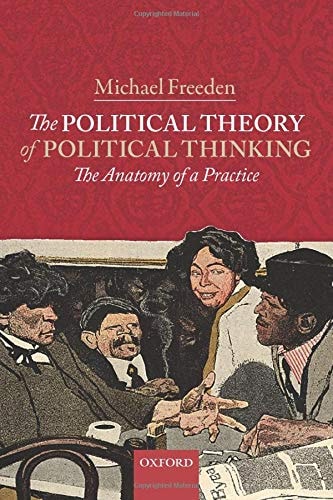
The Political Theory of Political Thinking: The Anatomy of a Practice
0
0
As an Amazon Associate and affiliate partner, Menrva Books earns from qualifying purchases. Learn more
Author Description
What does it mean to say that human beings think politically, and what is distinctive about that kind of thinking? That question is all-too infrequently asked by political theorists, or is dealt with through generalizations, abstractions, and dichotomies. This study examines the actual, real-world patterns people display when thinking politically, identifying six features of political thinking. They include the role of making ultimate decisions and regulating all social affairs, ranking collective priorities, mobilizing support for groups or withholding it, conceptualizing social order and stability as well as disorder and instability, projecting future visions and constructing plans for a society, and engaging the power aspects embedded in language, by means of reason, rhetoric, emotion or menace. Concurrently the untidiness and occasional failures of thinking politically are acknowledged alongside its quest for neatness.A large number of case studies is employed, drawn both from professional political theorists and philosophers and from various instances of vernacular usage: politicians, political commentators, or protest groups. Both contemporary and historical evidence from different cultures is utilized in illustrating the theoretical framework of the book. This is the first systematic study of political thinking as a cluster of thought-practices, combining insights from political theory--traditional and recent--the study of language and discourse, and political science. This investigation of 'the political' as a mode of thinking challenges many conventional understandings of political thought in the current literature, teases out what is political--not philosophical or ethical--in political theory, and locates it as a complex and ubiquitous social practice present at all points of human interaction and at diverse levels of articulation.
Menrva's Summary
THE THESIS
This book investigates the fundamental nature of political thinking as a distinct, ubiquitous social practice rather than a mere abstraction. Michael Freeden, a prominent scholar in political ideology, utilizes a multidisciplinary framework to dissect how individuals and groups construct political meaning. By synthesizing traditional theory with discourse analysis and political science, he argues that political thinking is a cluster of specific, identifiable practices that operate across all levels of human interaction.
THE SCOPE MAP
What You Will Find
- A six-part taxonomy defining the core features of political thinking, including decision-making, priority ranking, and power dynamics.
- An analysis of the tension between the human desire for conceptual order and the inherent untidiness of political reality.
- A diverse range of case studies spanning professional philosophical discourse and vernacular usage by politicians and activists.
- A comparative examination of historical and contemporary evidence from various cultural contexts.
THE AUTHORITY PERSPECTIVE
Scholars recognize this work as a significant contribution to the study of political ideology and the mechanics of discourse. Readers frequently note the academic density of the prose, which serves as a foundational text for those examining the intersection of language and political practice.
Page Count:
360
Publication Date:
2015-10-13
Publisher:
Oxford University Press
ISBN-10:
0198746733
ISBN-13:
9780198746737
Philosophy
Social Science
Thought And Thinking
Political Theory
Discourse Analysis
Community Tags
Similar Books