Social Change in Western Europe
0
0
As an Amazon Associate and affiliate partner, Menrva Books earns from qualifying purchases. Learn more
Author Description
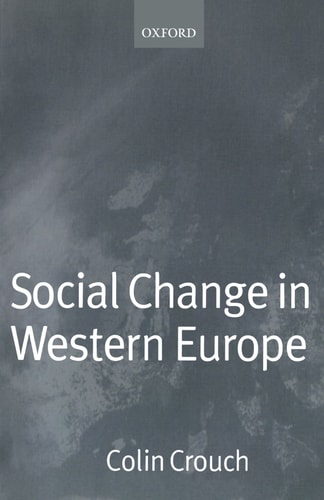
What do European societies look like, at the end of a turbulent millennium which saw western Europe slowly rise to global domination, and then rapidly decline to its present position, prosperous but clearly behind the USA in world influence? This is the only book by a single sociologist to make a systematic and up to date comparison of virtually all west European countries across a wide range of social institutions. These include: work and occupations, the structure of the economy, the family, education, religion, nationality and ethnicity, and the mechanism of citizenship in the welfare state. Particular emphasis is placed on the place of gender and social class. By including basic details on Japan and the United States throughout, the author is able to draw attention to any shared west European specificities. The book also develops a theory of change in contemporary societies. Starting from a model of a mid-century social compromise based on certain balances between industrialism, capitalism, traditional community institutions, and community it traces its subsequent destabilization and places particular importance on the resurgence of capitalism in shaping a new social order. This important new study of the social structure of western Europe will be essential reading for all students of comparative sociology and European sociology.
Menrva's Summary
THE THESIS
This book investigates the structural evolution of Western European societies following the region's transition from global dominance to its contemporary status within the global order. Colin Crouch, a prominent sociologist, utilizes a comparative framework to analyze how social institutions have shifted in response to economic and political pressures. By contrasting European developments with those in Japan and the United States, the author constructs a theory of social change that highlights the destabilization of mid-century compromises and the subsequent resurgence of capitalism.
THE SCOPE MAP
What You Will Find
- Comparative analysis of social institutions including work, family, education, and religion across Western European nations.
- A theoretical model tracing the shift from mid-century social compromises to modern capitalist-driven structures.
- Integration of cross-national data sets comparing European trends with the United States and Japan.
- Examination of the roles of gender, social class, and citizenship within the welfare state.
THE AUTHORITY PERSPECTIVE
Experts recognize this work as a comprehensive, systematic resource for comparative sociology students and researchers. Readers frequently note the academic density of the prose and the author's ability to synthesize complex institutional changes into a coherent theoretical framework.
Page Count:
568
Publication Date:
2000-01-01
Publisher:
Oxford University Press
ISBN-10:
0198742754
ISBN-13:
9780198742753
Economics
European History
Sociology
Social change
Europe
Social Science