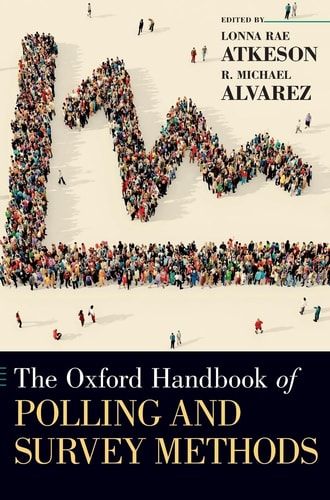
The Oxford Handbook of Polling and Survey Methods
0
0
As an Amazon Associate and affiliate partner, Menrva Books earns from qualifying purchases. Learn more
Author Description
The methodologies used to study public opinion are now in flux. The primary polling method of the last half-century, the telephone survey, is rapidly becoming obsolete as a data collection method. At the same time, new methods of contacting potential respondents and obtaining their response are appearing, providing a variety of options for scholars and practitioners. Generally speaking, we are moving from a polling world that was largely interviewer driven over the phone and face-to-face to predominantly interviewer driven self-administered poll environments, New methods of data collection, however, must still deal with fundamental questions to polling methodology and total survey error including sampling, selection bias, non-response error, poststratification weighting, and questionnaire design features.The Oxford Handbook on Polling and Survey Methods brings together a unique mixture of academics and practitioners, from various backgrounds, academic disciplines, and experiences. In some sense, this is reflective of the interdisciplinary nature of the polling and survey industry: polls and surveys are widely used in academia, government, and the private sector. Designing, implementing, and analyzing high quality, accurate, and cost-effective polls and surveys requires a combination of skills and methodological perspectives. Despite the well-publicized issues that have cropped up in recent political polling, a great deal is known today about how to collect high quality polling and survey data even in complex and difficult environments. Divided into four main sections, the Handbook draws on the existing research and explores data collection methods. It then addresses data analysis and the methods available for combining polling data with other types of data. The next section covers analytic issues, including the new approaches to studying public opinion (ie social media, the analysis of open-ended questions using text analytic tools, and data imputation). The final s
Menrva's Summary
THE THESIS
This volume investigates the evolving methodologies of public opinion research in an era where traditional telephone polling is becoming obsolete. Editors Lonna Rae Atkeson and R. Michael Alvarez curate contributions from a diverse group of academics and practitioners to address the transition toward self-administered survey environments. The text provides a comprehensive framework for navigating total survey error, sampling challenges, and the integration of modern data collection techniques within academic, governmental, and private sectors.
THE SCOPE MAP
What You Will Find
- Analysis of sampling, selection bias, and non-response error mitigation
- Methodologies for poststratification weighting and questionnaire design
- Techniques for integrating social media data and text analytic tools
- Approaches to data imputation and combining disparate data sources
- Case studies from interdisciplinary polling environments
Scope Limits
- The text does not provide a historical narrative of polling beyond its relevance to current methodological shifts
- It does not serve as a basic introductory guide for individuals without prior statistical or research design knowledge
THE AUTHORITY PERSPECTIVE
Experts identify this handbook as a critical resource for understanding the technical transition in survey research. Readers frequently note the academic density of the prose, which makes it a standard reference for professionals and graduate-level researchers in the field.
Page Count:
672
Publication Date:
2018-08-22
Publisher:
Oxford University Press
ISBN-10:
0190213299
ISBN-13:
9780190213299
Sociology
Statistics
Social Surveys
Research Methods
Public opinion
Data Analysis
Community Tags
Other Editions(2)
Similar Books





Reader Comments
Share Your Thoughts
No comments yet. Be the first to share your thoughts!