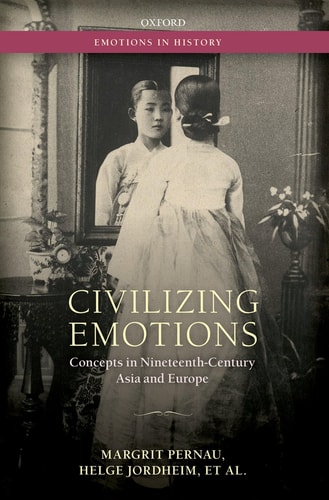
Civilizing Emotions: Concepts in Nineteenth Century Asia and Europe
0
0
As an Amazon Associate and affiliate partner, Menrva Books earns from qualifying purchases. Learn more
Author Description
At the beginning of the twenty-first century, the vocabulary of civility and civilization is very much at the forefront of political debate. Most of these debates proceed as if the meaning of these words were self-evident. This is where Civilizing Emotions intervenes, tracing the history of the concepts of civility and civilization and thus adding a level of self-reflexivity to the present debates. Unlike previous histories, Civilizing Emotions takes a global perspective, highlighting the roles of civility and civilization in the creation of a new and hierarchized global order in the era of high imperialism and its entanglements with the developments in a number of well-chosen European and Asian countries.Emotions were at the core of the practices linked to the creation of a new global order in the nineteenth century. Civilizing Emotions explores why and how emotions were an asset in civilizing peoples and societies - their control and management, but also their creation and their ascription to different societies and social groups. The study is a contribution to the history of emotions, to global history, and to the history of concepts, three rapidly developing and innovative research areas which are here being brought together for the first time.
Menrva's Summary
THE THESIS
This volume investigates how the concepts of civility and civilization were constructed and utilized through the management of emotions during the nineteenth century. The authors, a collaborative group of historians and scholars, argue that the vocabulary of civilization was not self-evident but rather a tool for establishing a hierarchical global order during the era of high imperialism. By synthesizing the history of emotions with global history and conceptual history, the text provides a framework for understanding how emotional ascription functioned as a mechanism of social and political control across European and Asian contexts.
THE SCOPE MAP
What You Will Find
- Comparative analysis of civilizing discourses in various European and Asian nations during the nineteenth century.
- Examination of the intersection between imperial expansion and the management of emotional expression.
- Historical methodology focusing on the evolution of political and social concepts.
- Case studies demonstrating how emotional norms were used to categorize and rank different social groups.
THE AUTHORITY PERSPECTIVE
Scholars in the field of global history and the history of emotions identify this work as a significant interdisciplinary contribution that bridges disparate research areas. Readers frequently note the academic density of the prose and the rigorous analytical approach applied to the study of conceptual history.
Page Count:
320
Publication Date:
2015-11-05
Publisher:
Oxford University Press
ISBN-10:
0198745532
ISBN-13:
9780198745532
History
Philosophy
Sociology
Social History
Cultural History
Political History
Community Tags
Similar Books