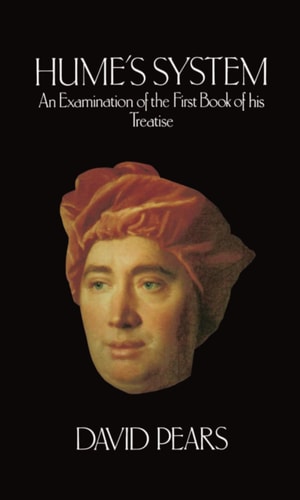
Hume's System: An Examination of the First Book of his Treatise
0
0
As an Amazon Associate and affiliate partner, Menrva Books earns from qualifying purchases. Learn more
Author Description
In this compelling analysis David Pears examines the foundations of Hume's theory of the mind as presented in the first book of the Treatise. Past studies have tended to take one of two extreme views: that Hume relies exclusively on a theory of meaning, or that he relies exclusively on a theory of truth and evidence. Steering a middle course between these positions, Pears argues that Hume's theory of ideas serves both functions. He examines in detail its application to three difficult problems: causation, personal identity, and sense perception. Hume's solutions, Pears argues, are not theories that can be given a place in standard classification of philosophical theories, but rather depend upon a subtle form of naturalism not altogether unlike Wittgenstein's naturalism. A clearly written and argued study, Hume's System will be of special interest to students and scholars of the history of philosophy.
Menrva's Summary
THE THESIS
This book investigates whether David Hume’s theory of ideas in the first book of his Treatise functions primarily as a theory of meaning or a theory of truth and evidence. David Pears, a noted philosopher, challenges the traditional binary interpretation of Hume’s work. He argues that Hume’s framework serves both functions simultaneously, rooted in a subtle form of naturalism that shares conceptual parallels with the philosophy of Ludwig Wittgenstein.
THE SCOPE MAP
What You Will Find
- A detailed examination of Hume’s theory of the mind as presented in the first book of the Treatise.
- An analysis of three core philosophical problems: causation, personal identity, and sense perception.
- A comparative methodology linking Hume’s naturalism to later philosophical developments.
- A critical synthesis that rejects standard classification of Hume’s solutions.
THE AUTHORITY PERSPECTIVE
Scholars recognize this work as a significant contribution to the study of Humean epistemology, particularly for its nuanced middle-ground approach. Readers frequently note the clarity of Pears's prose, which makes complex philosophical arguments accessible to both students and advanced researchers in the field.
Page Count:
224
Publication Date:
1991-02-21
Publisher:
Oxford University Press
ISBN-10:
0198751001
ISBN-13:
9780198751007
Philosophy
Epistemology
Metaphysics