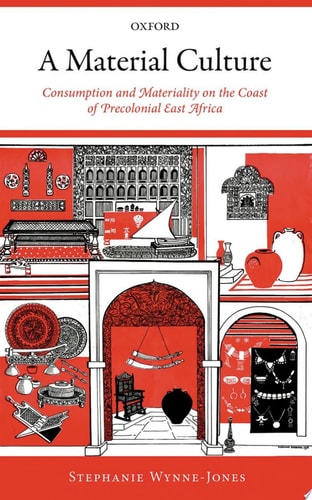
A Material Culture: Consumption and Materiality on the Coast of Precolonial East Africa
0
0
As an Amazon Associate and affiliate partner, Menrva Books earns from qualifying purchases. Learn more
Author Description
A Material Culture focuses on objects in Swahili society through the elaboration of an approach that sees both people and things as caught up in webs of mutual interaction. It therefore provides both a new theoretical intervention in some of the key themes in material culture studies, including the agency of objects and the ways they were linked to social identities, through the development of the notion of a biography of practice.These theoretical discussions are explored through the archaeology of the Swahili, on the Indian Ocean coast of eastern Africa. This coast was home to a series of "stonetowns" (containing coral architecture) from the ninth century AD onwards, of which Kilwa Kisiwani is the most famous, considered here in regional context. These stonetowns were deeply involved in maritime trade, carried out among a diverse, Islamic population.This book suggests that the Swahili are a highly-significant case study for exploration of the relationship between objects and people in the past, as the society was constituted and defined through a particular material setting. Further, it is suggested that this relationship was subtly different than in other areas, and particularly from western models that dominate prevailing analysis. The case is made for an alternative form of materiality, perhaps common to the wider Indian Ocean world, with an emphasis on redistribution and circulation rather than on the accumulation of wealth. The reader will therefore gain familiarity with a little-known and fascinating culture, as well as appreciating the ways that non-western examples can add to our theoretical models.
Menrva's Summary
THE THESIS
This book investigates how the material culture of Swahili stonetowns on the East African coast challenges Western-centric models of consumption and social identity. Stephanie Wynne-Jones, an expert in Swahili archaeology, utilizes archaeological evidence from sites like Kilwa Kisiwani to argue that Swahili society was defined by a unique form of materiality. By proposing a 'biography of practice,' the author demonstrates that these coastal communities prioritized the circulation and redistribution of objects over the accumulation of wealth, offering a critical alternative to prevailing theoretical frameworks.
THE SCOPE MAP
What You Will Find
- Archaeological analysis of coral architecture and material remains in Swahili stonetowns.
- A theoretical framework for understanding the agency of objects and their role in social identity.
- Comparative study of Indian Ocean maritime trade networks from the ninth century AD onwards.
- An exploration of non-Western models of consumption and wealth distribution.
THE AUTHORITY PERSPECTIVE
Scholars recognize this work as a significant contribution to the study of African archaeology and material culture theory. Readers frequently note the academic density of the prose, which serves as a foundational text for those interested in the social history of the Indian Ocean world.
Page Count:
264
Publication Date:
2016-07-19
Publisher:
Oxford University Press
ISBN-10:
0198759312
ISBN-13:
9780198759317
History
Anthropology
African history
Africa
Archaeology
Community Tags
Similar Books