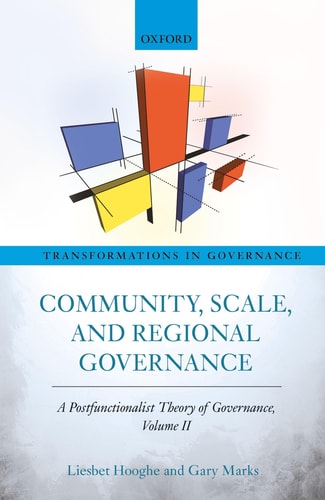
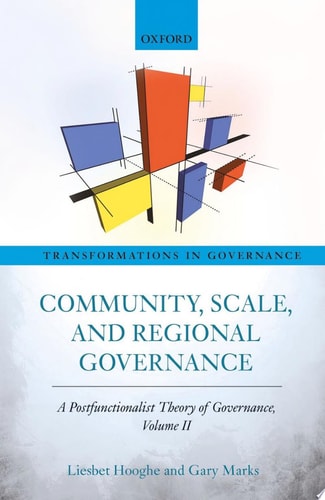
Community, Scale, and Regional Governance: A Postfunctionalist Theory of Governance, Volume II
0
0
As an Amazon Associate and affiliate partner, Menrva Books earns from qualifying purchases. Learn more
Author Description
This is the second of five ambitious volumes theorizing the structure of governance above and below the central state. This book is written for those interested in the character, causes, and consequences of governance within the state.The book argues that jurisdictional design is shaped by the functional pressures that arise from the logic of scale in providing public goods and by the preferences that people have regarding self-government. The first has to do with the character of the public goods provided by government: their scale economies, externalities, and informational asymmetries. The second has to do with how people conceive and construct the groups to which they feel themselves belonging. In this book, the authors demonstrate that scale and community are principles that can help explain some basic features of governance, including the growth of multiple tiers over the past six decades, how jurisdictions are designed, why governance within the state has become differentiated, and the extent to which regions exert authority. The authors propose a postfunctionalist theory which rejects the notion that form follows function, and argue that whilst functional pressures are enduring, one must engage human passions regarding self-rule to explain variation in the structures of rule over time and around the world.Transformations in Governance is a major new academic book series from Oxford University Press. It is designed to accommodate the impressive growth of research in comparative politics, international relations, public policy, federalism, environmental and urban studies concerned with the dispersion of authority from central states up to supranational institutions, down to subnational governments, and side-ways to public-private networks. It brings together work that significantly advances our understanding of the organization, causes, and consequences of multilevel and complex governance. The series is selective, containing annually a small number of books.
Menrva's Summary
THE THESIS
This volume investigates the core question of how jurisdictional design is shaped by the interplay between functional pressures and human community identity. Authors Gary Marks and Liesbet Hooghe, both established scholars in comparative politics and multilevel governance, present a postfunctionalist theory that challenges the traditional view that form follows function. They argue that while functional requirements for public goods are significant, the variation in governance structures across the globe can only be fully understood by accounting for human passions regarding self-rule and collective belonging.
THE SCOPE MAP
What You Will Find
- A theoretical framework analyzing the logic of scale in the provision of public goods, including economies of scale and externalities.
- An examination of the role of community identity and self-government preferences in shaping jurisdictional boundaries.
- Analysis of the growth and differentiation of subnational and supranational governance tiers over the past six decades.
- Empirical evidence explaining why authority is dispersed from central states to regional and local levels.
THE AUTHORITY PERSPECTIVE
Experts in political science and federalism recognize this work as a foundational text for understanding the complexities of multilevel governance. Readers frequently note the academic density of the prose, which provides a rigorous, systematic approach to institutional design that is highly regarded in graduate-level research.
Page Count:
224
Publication Date:
2016-10-18
Publisher:
Oxford University Press
ISBN-10:
0198766971
ISBN-13:
9780198766971
Federalism
Governance
Radicalism
Comparative Politics
Public Policy
Community Tags
Similar Books





Reader Comments
Share Your Thoughts
No comments yet. Be the first to share your thoughts!