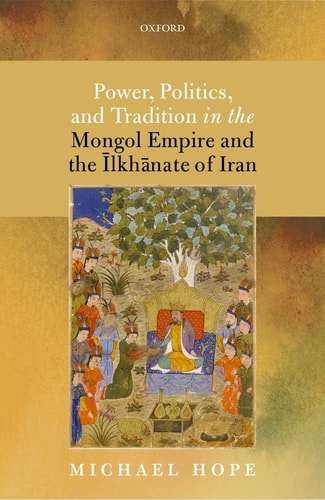
Power, Politics, and Tradition in the Mongol Empire and the Ilkhanate of Iran
0
0
As an Amazon Associate and affiliate partner, Menrva Books earns from qualifying purchases. Learn more
Author Description
This study provides a new interpretation of how political authority was conceived and transmitted in the Early Mongol Empire (1227-1259) and its successor state in the Middle East, the Ikhanate (1258-1335). Authority within the Mongol Empire was intimately tied to the character of its founder, Chinggis Khan, whose reign served as an idealized model for the exercise of legitimate authority amongst his political successors.Yet Chinggis Khan's legacy was interpreted differently by the various factions within his army. In the years after his death, two distinct political traditions emerged within the Mongol Empire, the collegial and the patrimonialist. Each of these streams represented the economic and political interests of different groups within the Mongol Empire, respectively, the military aristocracy and the central government. The supporters of both streams claimed to adhere to the ideal of Chinggisid rule, but their different statuses within the Mongol community led them to hold divergent views of what constituted legitimate political authority.Michael Hope's study details the origin of, and the differences between, these two streams of tradition; analyzing the role that these streams played in the political development of the Mongol Empire and the lkhanate; and assessing the role that ideological tension between the two streams played in the events leading up to the division of the Ilkhanate. Hope demonstrates that the policy and identity of both the Early Mongol Empire and the Ilkhanate were defined by the conflict between these competing streams of Chinggisid authority.
Menrva's Summary
THE THESIS
This study investigates how competing interpretations of Chinggisid authority shaped the political development and eventual fragmentation of the Early Mongol Empire and the Ilkhanate of Iran. Michael Hope examines the ideological divide between collegial and patrimonialist traditions, arguing that these conflicting concepts of legitimacy were not merely abstract ideals but were deeply rooted in the economic and political interests of the military aristocracy and the central government. By analyzing the period from 1227 to 1335, the author demonstrates how these divergent views of power dictated the governance and stability of the Mongol state.
THE SCOPE MAP
What You Will Find
- Analysis of the political transition from the Early Mongol Empire to the Ilkhanate.
- Examination of the collegial versus patrimonialist political traditions.
- Assessment of ideological tensions as a catalyst for the division of the Ilkhanate.
- Historical evaluation of the legacy of Chinggis Khan as a model for legitimate rule.
THE AUTHORITY PERSPECTIVE
Scholars recognize this work as a significant contribution to the study of Mongol political culture and state formation. Readers frequently note the academic density of the prose and the author's meticulous attention to the ideological underpinnings of medieval governance.
Page Count:
272
Publication Date:
2016-12-06
Publisher:
Oxford University Press
ISBN-10:
0198768591
ISBN-13:
9780198768593
History
Iran
Mongols history
Military History
Asian History
Community Tags
Similar Books