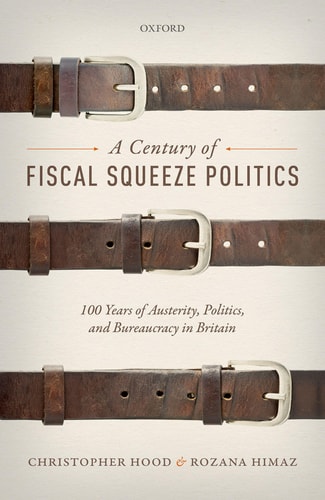
A Century of Fiscal Squeeze Politics: 100 Years of Austerity, Politics, and Bureaucracy in Britain
0
0
As an Amazon Associate and affiliate partner, Menrva Books earns from qualifying purchases. Learn more
Author Description
This volume identifies and compares 'fiscal squeezes' (major efforts to cut public spending and/or raise taxes) in the UK over a century from 1900 to 2015. The authors examine how different the politics of fiscal squeeze and austerity is today from what it was a century ago, how (if at all) fiscal squeezes reshaped the state and the provision of public services, and how political credit and blame played out after austerity episodes. The analysis is both quantitative and qualitative, starting with reported financial outcomes from historical statistics and then going behind those numbers to explore the political choices and processes in play. This analysis identifies some patterns that have not been explained or even recognized in earlier works on retrenchment and austerity. For example, it identifies a long term shift from what it terms a 'surgery without anaesthetics' approach (deep but short-lived episodes of spending restraint or tax increases) in the earlier part of the period towards a 'boiling frogs' approach (episodes in which the pain is spread out over a longer period) in more recent decades. It also identifies a curious reduction of revenue-led squeezes in more recent decades, and a puzzle over why blame-avoidance logic only led to outsourcing painful decisions over squeeze in a minority of cases. Furthmore, the volume's distinctive distinctive approach to classifying types of fiscal squeezes and qualitatively assessing their intensity seeks to solve the puzzle as to why voter 'punishment' of governments that impose austerity policies seems to be so erratic.
Menrva's Summary
THE THESIS
This volume investigates the evolution of fiscal squeeze politics in the United Kingdom over the course of a century, questioning how austerity strategies have shifted from rapid, intense interventions to prolonged, incremental measures. The authors, Christopher P. Hood and Rozanna Himaz, utilize a combination of historical financial statistics and qualitative political analysis to map the trajectory of public spending cuts and tax increases from 1900 to 2015. By examining the mechanisms of blame-avoidance and the impact of these policies on state structure, the authors provide a framework for understanding why voter responses to austerity remain inconsistent across different historical eras.
THE SCOPE MAP
What You Will Find
- A comprehensive longitudinal study of fiscal squeezes in the UK spanning 1900 to 2015.
- A comparative methodology contrasting 'surgery without anaesthetics' versus 'boiling frogs' approaches to austerity.
- Quantitative analysis of historical financial statistics paired with qualitative assessments of political decision-making.
- An examination of the relationship between austerity episodes, state restructuring, and the political consequences of blame-avoidance.
THE AUTHORITY PERSPECTIVE
Experts recognize this work as a significant contribution to the study of public administration and political economy, noting its ability to identify previously overlooked patterns in long-term fiscal policy. Readers frequently highlight the clarity of the authors' classification systems and the rigor with which they analyze the shifting logic of government spending restraint.
Page Count:
280
Publication Date:
2017-08-08
Publisher:
Oxford University Press
ISBN-10:
0198779615
ISBN-13:
9780198779612
Politics
History
Economics
British History
Public Policy
Great Britain
Community Tags
Similar Books