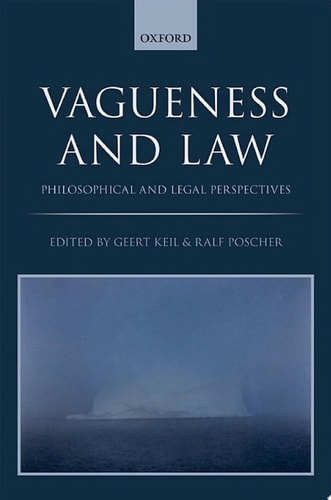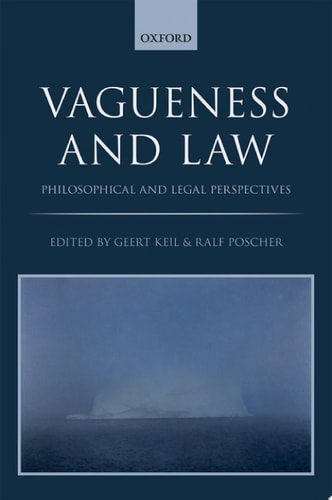
Vagueness in the Law: Philosophical and Legal Perspectives
0
0
As an Amazon Associate and affiliate partner, Menrva Books earns from qualifying purchases. Learn more
Author Description
Vague expressions are omnipresent in natural language. As such, their use in legal texts is virtually inevitable. If a law contains vague terms, the question whether it applies to a particular case often lacks a clear answer. One of the fundamental pillars of the rule of law is legal certainty. The determinacy of the law enables people to use it as a guide and places judges in the position to decide impartially. Vagueness poses a threat to these ideals. In borderline cases, the law seems to be indeterminate and thus incapable of serving its core rule of law value.In the philosophy of language, vagueness has become one of the hottest topics of the last two decades. Linguists and philosophers have investigated what distinguishes "soritical" vagueness from other kinds of linguistic indeterminacy, such as ambiguity, generality, open texture, and family resemblance concepts. There is a vast literature that discusses the logical, semantic, pragmatic, and epistemic aspects of these phenomena. Legal theory has hitherto paid little attention to the differences between the various kinds of linguistic indeterminacy that are grouped under the heading of "vagueness", let alone to the various theories that try to account for these phenomena.Bringing together leading scholars working on the topic of vagueness in philosophy and in law, this book fosters a dialogue between philosophers and legal scholars by examining how philosophers conceive vagueness in law from their theoretical perspective and how legal theorists make use of philosophical theories of vagueness. The chapters of the book are organized into three parts. The first part addresses the import of different theories of vagueness for the law, referring to a wide range of theories from supervaluationist to contextualist and semantic realist accounts in order to address the question of whether the law can learn from engaging with philosophical discussions of vagueness. The second part of the book examines different vaguenes
Menrva's Summary
THE THESIS
This book investigates the fundamental tension between the inherent vagueness of natural language and the requirement for legal certainty within the rule of law. Editors Geert Keil and Ralf Poscher assemble a collection of essays from philosophers and legal scholars to analyze how linguistic indeterminacy affects judicial decision-making. By bridging the gap between philosophy of language and jurisprudence, the text evaluates whether formal theories of vagueness can provide practical solutions for legal interpretation.
THE SCOPE MAP
What You Will Find
- Comparative analysis of soritical vagueness, ambiguity, generality, and open texture concepts.
- Evaluation of philosophical frameworks including supervaluationism, contextualism, and semantic realism.
- Interdisciplinary dialogue between linguistic theorists and legal practitioners.
- Examination of how vague legal terms impact the impartiality and predictability of judicial outcomes.
THE AUTHORITY PERSPECTIVE
Experts identify this collection as a significant contribution to the intersection of analytical philosophy and legal theory. Readers frequently note the academic density of the prose, which serves as a specialized resource for scholars interested in the mechanics of legal interpretation.
Page Count:
350
Publication Date:
2017-02-08
Publisher:
Oxford University Press
ISBN-10:
0198782888
ISBN-13:
9780198782889
Philosophy
Law
Interpretation and construction
Legal Theory
Jurisprudence
Linguistics
Community Tags
Similar Books