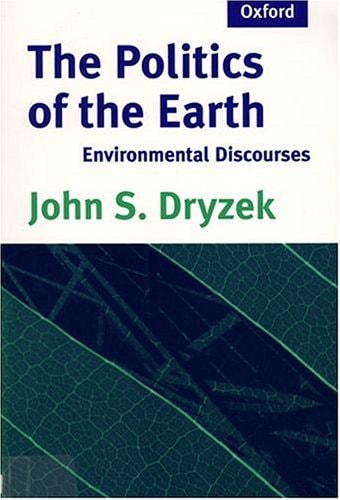
The Politics of the Earth: Environmental Discourses
0
0
As an Amazon Associate and affiliate partner, Menrva Books earns from qualifying purchases. Learn more
Author Description
The Politics of the Earth provides an excellent and accessible introduction to thinking about the environment by looking at the way people use language on environmental issues. John Dryzek helps make sense of the diverse developments in environmental politics by analyzing the main discourses which have dominated the area during the last three decades, and which are likely to be influential in the future:Survivalism - based on the contention that the Earth has a limited stock of resources and prescribes drastic, multidimensional action to prevent global disaster, receiving a reply from Prometheans who deny such limits exist.Environmental Problem Solving - recognizes the existence of ecological problems but views them as tractable within the basic framework of industrial society.Sustainability - defined by imaginative attempts to dissolve the conflicts between environmental and economic values.Green Radicalism - rejects the basic structure of industrial society and the way the environment is conceptualized and promotes transformation in human consciousness, economics, and politics.John Dryzek provides a comprehensive and lively assessment of these various perspectives, their rise and fall, their interaction and impacts, and their strengths and weaknesses. His analysis of these discourses leads up to a concluding argument for a reinvigorated ecological democracy.The Politics of the Earth offers a new way of classifying and comparing the main strands of environmental politics. It will be fascinating and essential reading for all students of environmental politics and policy, and for anyone with an interest in environmental issues.
Menrva's Summary
THE THESIS
This book investigates how language and discourse shape the development, influence, and trajectory of environmental politics over the last three decades. John S. Dryzek, a prominent scholar in political science and environmental theory, utilizes a discourse-analytic framework to categorize the competing ways in which environmental issues are framed. By examining the rhetorical strategies of various political actors, he argues that understanding these discourses is critical for navigating the transition toward a more robust ecological democracy.
THE SCOPE MAP
What You Will Find
- Analysis of four primary environmental discourses: Survivalism, Environmental Problem Solving, Sustainability, and Green Radicalism.
- A comparative framework for evaluating the strengths, weaknesses, and historical impacts of different environmental ideologies.
- Examination of the tension between industrial society frameworks and ecological imperatives.
- A concluding argument advocating for the institutionalization of ecological democracy as a solution to current political impasses.
THE AUTHORITY PERSPECTIVE
Experts and academics frequently cite this work as a foundational text for students of environmental politics due to its clear taxonomy of complex political ideologies. Readers often note the accessibility of the prose, which successfully distills dense theoretical concepts into a coherent structure for both undergraduate and graduate study.
Page Count:
240
Publication Date:
1997-11-06
Publisher:
Oxford University Press
ISBN-10:
0198781598
ISBN-13:
9780198781592
Green movement
Sociology
Public Policy
Community Tags
Similar Books