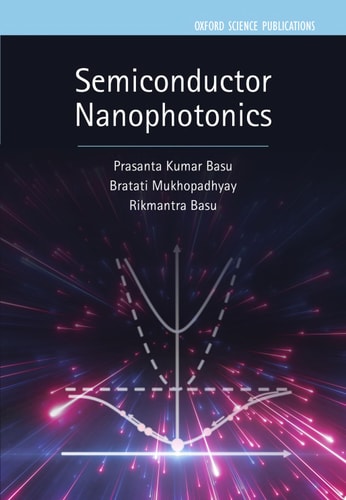
Semiconductor Nanophotonics
0
0
As an Amazon Associate and affiliate partner, Menrva Books earns from qualifying purchases. Learn more
Author Description
Nanometre sized structures made of semiconductors, insulators, and metals and grown by modern growth technologies or by chemical synthesis exhibit novel electronic and optical phenomena due to the confinement of electrons and photons. Strong interactions between electrons and photons in narrow regions lead to inhibited spontaneous emission, thresholdless laser operation, and Bose-Einstein condensation of exciton-polaritons in microcavities. Generation of sub-wavelength radiation by surface plasmon-polaritons at metal-semiconductor interfaces, creation of photonic band gaps in dielectrics, and realization of nanometer sized semiconductor or insulator structures with negative permittivity and permeability, known as metamaterials, are further examples in the area of Nanophotonics. The studies help develop spasers and plasmonic nanolasers of subwavelength dimensions, paving the way to use plasmonics in future data centres and high-speed computers working at THz bandwidth with less than a few fJ/bit dissipation.The present book is aimed at graduate students and researchers providing them with an introductory textbook on Semiconductor Nanophotonics. It gives an introduction to electron-photon interactions in Quantum Wells, Wires, and Dots and then discusses the processes in microcavities, photonic band gap materials, metamaterials, and related applications. The phenomena and device applications under strong light-matter interactions are discussed, mostly by using classical and semi-classical theories. Numerous examples and problems accompany each chapter.
Menrva's Summary
THE THESIS
This text investigates the fundamental physical phenomena and device applications arising from the interaction between electrons and photons within nanometer-sized semiconductor structures. The authors, Bratati Mukhopadhyay, Prasanta Kumar Basu, and Rikmantra Basu, utilize classical and semi-classical theoretical frameworks to explain how confinement effects in quantum wells, wires, and dots influence optical behavior. The book serves as a structured introduction for graduate students and researchers, bridging the gap between theoretical quantum mechanics and practical applications in high-speed computing and data transmission.
THE SCOPE MAP
What You Will Find
- Theoretical analysis of electron-photon interactions in quantum wells, wires, and dots.
- Examination of microcavities, photonic band gap materials, and metamaterials with negative permittivity.
- Discussion of advanced device applications including spasers and plasmonic nanolasers.
- Pedagogical support through numerous chapter-specific examples and problem sets.
THE AUTHORITY PERSPECTIVE
Experts identify this work as a foundational textbook for graduate-level study in the field of semiconductor physics. Readers frequently note the clarity of the theoretical derivations and the practical utility of the included problem sets for academic coursework.
Page Count:
592
Publication Date:
2022-07-05
Publisher:
Oxford University Press
ISBN-10:
0198784694
ISBN-13:
9780198784692
Science
Engineering
Photonics
Semiconductors
Nanotechnology
Physics