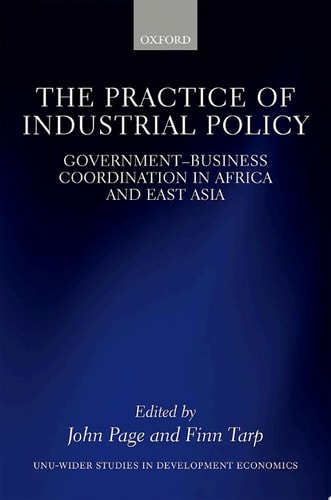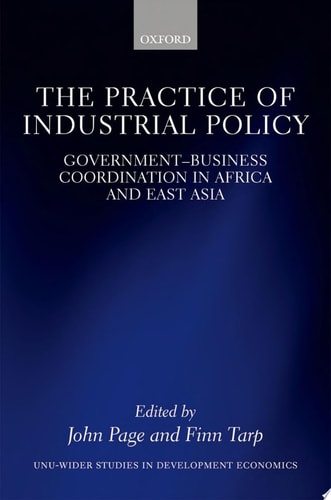
The Practice of Industrial Policy: Government-Business Coordination in Africa and East Asia
0
0
As an Amazon Associate and affiliate partner, Menrva Books earns from qualifying purchases. Learn more
Author Description
Much of the information relevant to policy formulation for industrial development is held by the private sector, not by public officials. There is therefore fairly broad agreement in the development literature that some form of structured engagement, often referred to as close or strategic coordination, between the public and private sectors is needed, both to assist in the design of appropriate policies and to provide feedback on their implementation. There is less agreement on how that engagement should be structured, how its objectives should be defined, and how success should be measured. In fact, the academic literature on close coordination provides little practical guidance on how governments interested in developing a framework for government business engagement should go about doing it.The burden of this lack of guidance falls most heavily on Africa, where ― despite 20 years of growth ― lack of structural transformation has slowed job creation and the pace of poverty reduction. Increasingly, African governments are seeking to design and implement policies to encourage the more rapid growth of high productivity industries and in the process confronting the need to engage constructively with the private sector. These efforts have met with mixed results. For sustained success in structural transformation, new policies and new approaches to government-business coordination will be needed.In 2014 the Korea International Cooperation Agency and UNU-WIDER launched a joint research project on 'The Practice of Industrial Policy'. The objective of the project was to help African policy-makers develop better coordination between the public and private sectors in order to identify the constraints to faster structural transformation and to design, implement, and monitor policies to remove them. This book, written by national researchers and international experts, presents the results of that research.
Menrva's Summary
THE THESIS
This book investigates the practical mechanisms for structured coordination between public officials and the private sector to facilitate industrial development and structural transformation. The authors, John M. Page Jr. and Finn Tarp, leverage a collaborative research project between the Korea International Cooperation Agency and UNU-WIDER to address the gap in development literature regarding the implementation of industrial policy. By analyzing the experiences of various nations, the text provides a framework for African policy-makers to identify constraints to growth and design effective, monitorable interventions that foster high-productivity industries.
THE SCOPE MAP
What You Will Find
- Comparative analysis of government-business coordination models in Africa and East Asia.
- Methodologies for identifying and removing constraints to structural transformation.
- Case studies authored by national researchers and international development experts.
- Frameworks for designing, implementing, and monitoring industrial policy feedback loops.
THE AUTHORITY PERSPECTIVE
Experts recognize this volume as a critical resource for bridging the gap between theoretical development economics and the practical realities of policy implementation. Readers frequently note the academic rigor of the case studies, which provide actionable insights for practitioners working in emerging economies.
Page Count:
312
Publication Date:
2017-06-06
Publisher:
Oxford University Press
ISBN-10:
0198796951
ISBN-13:
9780198796954
Economics
Industrial Policy
East Asia
Public Policy
Private Sector
Africa
Community Tags
Similar Books