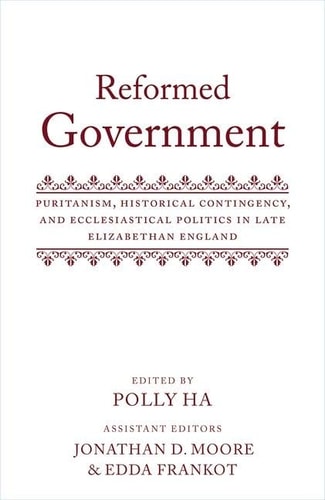
Reformed Government: Puritanism, Historical Contingency, and Ecclesiastical Politics in Late Elizabethan England
0
0
As an Amazon Associate and affiliate partner, Menrva Books earns from qualifying purchases. Learn more
Author Description
The culmination of cultural and literary achievements in the final decade of Elizabeth I's reign coincided with some of Tudor England's worst years economically which were exacerbated by plague, successive harvest failure, and belligerence at home and abroad. This critical edition of the scribal publication 'Reformed Government' c. 1594 provides a unique point of entry into the 1590s. Recovering a pivotal moment in the history of puritan radicalism, it represents the most extensive reformed response to the onslaught of anti-puritan literature in the late sixteenth century, including Richard Hooker's Laws of Ecclesiastical Polity. In addition to mounting an epistemological and ecclesiastical defence of reformed presbyterian government, it sheds light on new appropriations of Renaissance ideas about historical contingency, and introduces a dynamic reading of Christian antiquity. The edition also provides a wider context for later developments in the seventeenth century. Exploiting the instability of the period, the 'Reformed Government' seized the opportunity to re-imagine society and even anticipated the idea of altering civil and religious constitutions which theorists later developed in Revolutionary Britain. By expanding and reconfiguring the relationship between civil and ecclesiastical government, it imaginatively stretched the implications of historical change to entertain new possibilities. This recovery of an alternative vision of a reformed society in the late sixteenth century offers an alternative model for reading church history. Based on maximal visions and proposals of reform, the 'Reformed Government' is essential reading for the study of ecclesiastical tradition alongside confessional documents and summative statements.
Menrva's Summary
THE THESIS
This work investigates how the anonymous 1594 text 'Reformed Government' functioned as a radical intellectual response to the political and religious instability of late Elizabethan England. Authors Edda Frankot and Jonathan D. Moore provide a critical edition of this scribal publication, situating it within the broader context of Tudor economic crises and the intense theological debates surrounding Richard Hooker's work. By analyzing the text's defense of presbyterian governance, the authors argue that the document represents a sophisticated attempt to reconfigure the relationship between civil and ecclesiastical authority through the lens of historical contingency.
THE SCOPE MAP
What You Will Find
- A critical edition of the 1594 manuscript 'Reformed Government' with historical commentary.
- Analysis of the intellectual intersection between Renaissance historical theory and reformed theology.
- Examination of the polemical landscape of the 1590s, specifically the reaction against anti-puritan literature.
- Discussion of how late sixteenth-century reformist proposals anticipated later constitutional theories in Revolutionary Britain.
THE AUTHORITY PERSPECTIVE
Scholars recognize this edition as a significant contribution to the study of Elizabethan ecclesiastical politics and the development of radical puritan thought. The text is noted for its ability to bridge the gap between theological discourse and the practical political anxieties of the late sixteenth century.
Page Count:
272
Publication Date:
2022-10-11
Publisher:
Oxford University Press
ISBN-10:
0198798105
ISBN-13:
9780198798101
History
Religion
Theology Practical
Puritanism
Ecclesiastical History
Community Tags
Similar Books