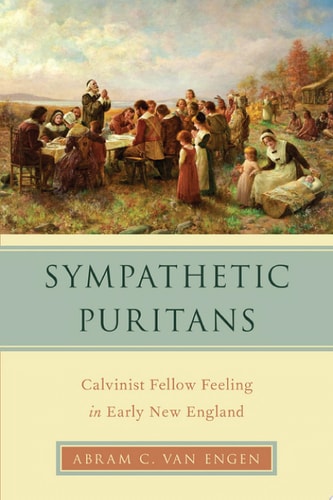
Sympathetic Puritans: Calvinist Fellow Feeling in Early New England
0
0
As an Amazon Associate and affiliate partner, Menrva Books earns from qualifying purchases. Learn more
Author Description
Revising dominant accounts of Puritanism and challenging the literary history of sentimentalism, Sympathetic Puritans argues that a Calvinist theology of sympathy shaped the politics, religion, rhetoric, and literature of early New England. Scholars have often understood and presented sentimentalism as a direct challenge to stern and stoic Puritan forebears; the standard history traces a cult of sensibility back to moral sense philosophy and the Scottish Enlightenment, not Puritan New England. Abram C. Van Engen has unearthed pervasive evidence of sympathy in a large archive of Puritan sermons, treatises, tracts, poems, journals, histories, and captivity narratives. He demonstrates how two types of sympathy -- the active command to fellow-feel (a duty), as well as the passive sign that could indicate salvation (a discovery) -- permeated Puritan society and came to define the very boundaries of English culture, affecting conceptions of community, relations with Native Americans, and the development of American literature.Van Engen re-examines the Antinomian Controversy, conversion narratives, transatlantic relations, Puritan missions, Mary Rowlandson's captivity narrative -- and Puritan culture more generally -- through the lens of sympathy. Demonstrating and explicating a Calvinist theology of sympathy in seventeenth-century New England, the book reveals the religious history of a concept that has previously been associated with more secular roots.
Menrva's Summary
THE THESIS
This book investigates how a Calvinist theology of sympathy functioned as a foundational element of early New England culture, challenging the traditional view that sentimentalism emerged solely from the later Scottish Enlightenment. Abram Van Engen, a scholar of American literature and religion, utilizes a vast archive of seventeenth-century primary sources to argue that sympathy was not a secular invention but a core component of Puritan religious duty and identity. By analyzing sermons, captivity narratives, and theological treatises, the author demonstrates that the capacity for fellow-feeling was central to how Puritans defined their community and their interactions with others.
THE SCOPE MAP
What You Will Find
- Analysis of the Antinomian Controversy and conversion narratives.
- Examination of Puritan missions and relations with Native Americans.
- A study of the dual nature of sympathy as both an active duty and a passive sign of salvation.
- Investigation into transatlantic religious and cultural exchanges.
Scope Limits
- The study focuses primarily on seventeenth-century New England and does not extend into the later developments of eighteenth-century moral philosophy.
- The analysis is restricted to the Calvinist theological framework and does not provide a comprehensive history of secular sentimentalism.
THE AUTHORITY PERSPECTIVE
Scholars recognize this work as a significant intervention in the study of early American religious history and literary development. Readers frequently note the academic density of the prose and the author's meticulous archival research in re-evaluating the origins of American sentimentalism.
Page Count:
328
Publication Date:
2015-01-01
Publisher:
Oxford University Press
ISBN-10:
0190266651
ISBN-13:
9780190266653
History
Religion
Calvinism
Christian literature
Puritanism
English
Literary Criticism
English & College Success
Puritans
Theology
American History
Community Tags
Other Editions(2)
Similar Books