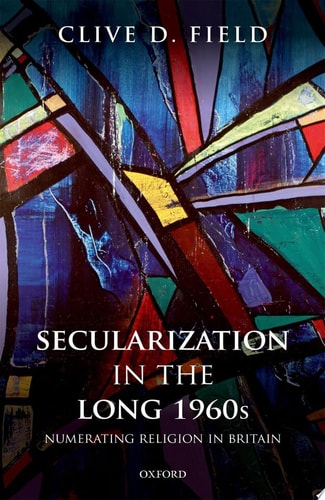
Secularization in the Long 1960s: Numerating Religion in Britain
0
0
As an Amazon Associate and affiliate partner, Menrva Books earns from qualifying purchases. Learn more
Author Description
Secularization in the Long 1960s: Numerating Religion in Britain provides a major empirical contribution to the literature of secularization. It moves beyond the now largely sterile and theoretical debates about the validity of the secularization thesis or paradigm. Combining historical and social scientific perspectives, Clive D. Field uses a wide range of quantitative sources to probe the extent and pace of religious change in Britain during the long 1960s. In most cases, data is presented for the years 1955-80, with particular attention to the methodological and other challenges posed by each source type.Following an introductory chapter, which reviews the historiography, introduces the sources, and defines the chronological and other parameters, Field provides evidence for all major facets of religious belonging, behaving, and believing, as well as for institutional church measures. The work engages with, and largely refutes, Callum G. Brown's influential assertion that Britain experienced 'revolutionary' secularization in the 1960s, which was highly gendered in nature, and with 1963 the major tipping-point. Instead, a more nuanced picture emerges with some religious indicators in crisis, others continuing on an existing downward trajectory, and yet others remaining stable. Building on previous research by the author and other scholars, and rejecting recent proponents of counter-secularization, the long 1960s are ultimately located within the context of a longstanding gradualist, and still ongoing, process of secularization in Britain.
Menrva's Summary
THE THESIS
This book investigates the extent and pace of religious change in Britain during the long 1960s to determine whether the period represented a revolutionary shift or a continuation of gradual secularization. Clive D. Field, a noted scholar in the sociology of religion, utilizes a robust collection of quantitative data to challenge existing historiographical narratives. By analyzing religious belonging, behaving, and believing through a methodological lens, the author argues against the notion of a sudden, gendered religious collapse in 1963. Instead, the text posits that the era is best understood as part of a long-term, incremental process of secular decline.
THE SCOPE MAP
What You Will Find
- Quantitative analysis of religious indicators from 1955 to 1980.
- Methodological evaluation of diverse source types used to measure religious activity.
- Comparative study of institutional church measures versus individual belief patterns.
- Critical engagement with the secularization thesis and the work of Callum G. Brown.
THE AUTHORITY PERSPECTIVE
Experts recognize this work as a significant empirical contribution to the study of religious history in Britain. Readers frequently note the academic density of the prose and the meticulous attention to methodological challenges in historical data collection.
Page Count:
248
Publication Date:
2017-05-23
Publisher:
Oxford University Press
ISBN-10:
0198799470
ISBN-13:
9780198799474
History
Religion
Secularization
Sociology
Great Britain
Secularism
Secularization Theology
British History
Community Tags
Similar Books