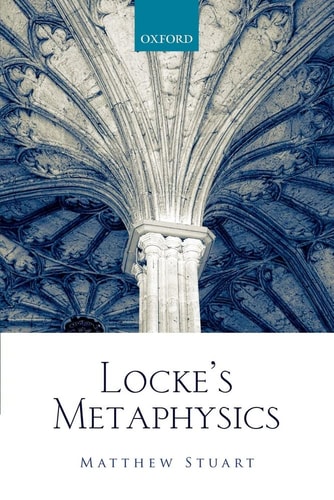
Locke's Metaphysics
0
0
As an Amazon Associate and affiliate partner, Menrva Books earns from qualifying purchases. Learn more
Author Description
Though John Locke set out to write a book that would resolve questions about the origin and scope of human knowledge, his Essay Concerning Human Understanding is also a profound contribution to metaphysics, full of arguments about the fundamental features of bodies, the notions of essence and kind, the individuation of material objects, personal identity, the nature and scope of volition, freedom of action, freedom of will, and the relationship between matter and mind. Matthew Stuart examines a broad range of these arguments, and explores the relationships between them. He offers fresh interpretations of such familiar material as the distinction between primary and secondary qualities, and Locke's account of personal identity; and he also takes us deeper into less familiar territory, including Locke's case against materialism and his philosophy of action.Locke's Metaphysics shows Locke to be a more consistent, systematic and interesting metaphysician than is generally appreciated. It defends him against charges of muddling the definition of 'quality', of waffling between two conceptions of secondary qualities, and of vacillating in his commitment to mechanism. It shows how his rejection of essentialism leads him to embrace relativism about identity, and that his relativism about identity is the key to defending his account of personal identity against several objections.Yet the picture of Locke that emerges is not always a familiar one. Stuart's account reveals that he is a philosopher who denies the existence of relations, who takes bodies to be colored only so long as we are looking at them, and who is not committed to mechanism. He shows that Locke takes persons to be three-dimensional beings whose pasts are 'gappy' rather than continuous. Finally, he shows that Locke is a volitionist who holds that we can will only our own thoughts and bodily motions, and not such episodes as lighting a candle or turning the pages of a book.
Menrva's Summary
THE THESIS
This book investigates whether John Locke’s Essay Concerning Human Understanding contains a coherent, systematic, and overlooked metaphysical framework. Matthew Stuart, a scholar of early modern philosophy, utilizes a rigorous analytical approach to re-examine Locke’s arguments regarding the nature of bodies, personal identity, and the freedom of the will. By challenging traditional interpretations, Stuart argues that Locke’s metaphysical commitments are more consistent and sophisticated than historical critiques have suggested.
THE SCOPE MAP
What You Will Find
- Analysis of Locke’s distinction between primary and secondary qualities.
- Examination of Locke’s rejection of essentialism and his subsequent embrace of relativism about identity.
- Investigation into Locke’s philosophy of action and his specific stance on volition.
- Critical evaluation of Locke’s arguments against materialism and his views on the relationship between matter and mind.
THE AUTHORITY PERSPECTIVE
Scholars and students of early modern philosophy frequently highlight this text for its ability to challenge long-standing interpretations of Locke’s work. Experts note that the prose is dense and highly analytical, making it a significant resource for those already familiar with the foundational arguments of the Essay Concerning Human Understanding.
Page Count:
544
Publication Date:
2017-09-01
Publisher:
Oxford University Press
ISBN-10:
0198805594
ISBN-13:
9780198805595
Philosophy
Non-Fiction
Epistemology
Philosophy British
Metaphysics
Community Tags
Other Editions(4)

Similar Books

Reader Comments
Share Your Thoughts
No comments yet. Be the first to share your thoughts!