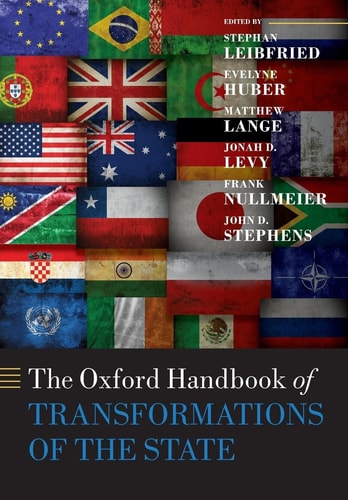
The Oxford Handbook of Transformations of the State
0
0
As an Amazon Associate and affiliate partner, Menrva Books earns from qualifying purchases. Learn more
Author Description
This Handbook offers a comprehensive treatment of transformations of the state, from its origins in different parts of the world and different time periods to its transformations since World War II in the advanced industrial countries, the post-Communist world, and the Global South.Leading experts in their fields, from Europe and North America, discuss conceptualizations and theories of the state and the transformations of the state in its engagement with a changing international environment as well as with changing domestic economic, social, and political challenges. The Handbook covers different types of states in the Global South (from failed to predatory, rentier and developmental), in different kinds of advanced industrial political economies (corporatist, statist, liberal, import substitution industrialization), and in various post-Communist countries (Russia, China, successor states to the USSR, and Eastern Europe). It also addresses crucial challenges in different areas of state intervention, from security to financial regulation, migration, welfare states, democratization and quality of democracy, ethno-nationalism, and human development.The volume makes a compelling case that far from losing its relevance in the face of globalization, the state remains a key actor in all areas of social and economic life, changing its areas of intervention, its modes of operation, and its structures in adaption to new international and domestic challenges.
Menrva's Summary
THE THESIS
This volume investigates how the modern state has evolved, adapted, and maintained its relevance amidst shifting global economic, social, and political pressures. Edited by a team of distinguished scholars including Evelyne Huber and Stephan Leibfried, the text synthesizes diverse theoretical frameworks to analyze state development across advanced industrial nations, post-Communist regimes, and the Global South. The authors argue that rather than declining in the face of globalization, the state has fundamentally restructured its modes of intervention and operational capacity to address contemporary challenges.
THE SCOPE MAP
What You Will Find
- Comparative analysis of state typologies including developmental, predatory, and rentier states.
- Examination of state transformations in post-WWII industrial economies and post-Communist transitions.
- Theoretical frameworks addressing security, financial regulation, migration, and welfare state policy.
- Empirical evidence covering democratization, ethno-nationalism, and human development metrics.
THE AUTHORITY PERSPECTIVE
Experts identify this volume as a comprehensive reference work that provides a rigorous academic overview of state theory and comparative political development. Readers frequently note the academic density of the prose, making it a foundational text for graduate-level research in political science and sociology.
Page Count:
924
Publication Date:
2017-07-20
Publisher:
OUP Oxford
ISBN-10:
0198808925
ISBN-13:
9780198808923
Economics
History
State The
Sociology
Public Policy
International relations
Community Tags
Similar Books