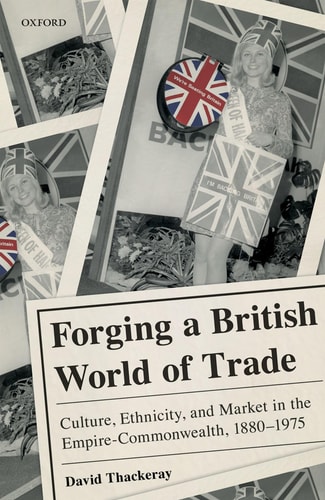
Forging a British World of Trade: Culture, Ethnicity, and Market in the Empire-Commonwealth, 1880-1975
0
0
As an Amazon Associate and affiliate partner, Menrva Books earns from qualifying purchases. Learn more
Author Description
Brexit is likely to lead to the largest shift in Britain's economic orientation in living memory. Some have argued that leaving the EU will enable Britain to revive markets in Commonwealth countries with which it has long-standing historical ties. Their opponents maintain that such claims are based on forms of imperial nostalgia which ignore the often uncomfortable historical trade relations between Britain and these countries, as well as the UK's historical role as a global, rather than chiefly imperial, economy.Forging a British World of Trade explores how efforts to promote a 'British World' system, centred on promoting trade between Britain and the Dominions, grew and declined in influence between the 1880s and 1970s. At the beginning of the twentieth century many people from London, to Sydney, Auckland, and Toronto considered themselves to belong to culturally British nations. British politicians and business leaders invested significant resources in promoting trade with Australia, Canada, New Zealand, and South Africa out of a perception that these were great markets of the future.However, ideas about promoting trade between 'British' peoples were racially exclusive. From the 1920s onwards, colonized and decolonizing populations questioned and challenged the basis of British World networks, making use of alternative forms of international collaboration promoted firstly by the League of Nations, and then by the United Nations. Schemes for imperial collaboration amongst ethnically 'British' peoples were hollowed out by the actions of a variety of political and business leaders across Asia and Africa who reshaped the functions and identity of the Commonwealth.
Menrva's Summary
THE THESIS
This book investigates the rise and decline of the 'British World' trade system and its reliance on cultural and ethnic identity between 1880 and 1975. David Thackeray, a historian specializing in British economic and imperial history, utilizes archival research and political analysis to demonstrate how trade networks were constructed around notions of shared British identity. The work argues that these networks were inherently racially exclusive and eventually collapsed under the pressure of decolonization and the emergence of alternative international organizations.
THE SCOPE MAP
What You Will Find
- Analysis of economic and political trade strategies between Britain, Australia, Canada, New Zealand, and South Africa.
- Examination of the intersection between racial identity and imperial market expansion.
- Historical evidence regarding the transition from imperial trade networks to United Nations-led international collaboration.
- Documentation of the resistance and agency of colonized populations in reshaping Commonwealth identity.
THE AUTHORITY PERSPECTIVE
Scholars recognize this work as a significant contribution to the understanding of how imperial nostalgia informs modern economic policy debates. Readers frequently note the academic rigor and the clarity with which the author connects historical trade patterns to contemporary geopolitical shifts.
Page Count:
256
Publication Date:
2019-04-14
Publisher:
Oxford University Press
ISBN-10:
0198816715
ISBN-13:
9780198816713
Politics
Economics
History
British Empire
Commonwealth
Trade
Great Britain
Community Tags
Similar Books