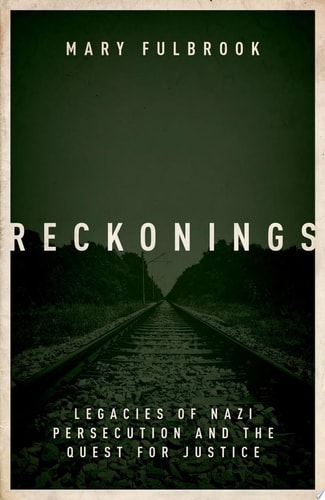
Reckonings: Legacies of Nazi Persecution
0
0
As an Amazon Associate and affiliate partner, Menrva Books earns from qualifying purchases. Learn more
Author Description
A single word--Auschwitz--is often used to encapsulate the totality of persecution and suffering involved in what we call the Holocaust. Yet a focus on a single concentration camp--however horrific what happened there, however massively catastrophic its scale--leaves an incomplete story, a truncated history. It cannot fully communicate the myriad ways in which individuals became tangled up on the side of the perpetrators, and obscures the diversity of experiences among a wide range of victims as they struggled and died, or managed, against all odds, to survive. In the process, we also miss the continuing legacy of Nazi persecution across generations, and across continents.Mary Fulbrook's encompassing book attempts to expand our understanding, exploring the lives of individuals across a full spectrum of suffering and guilt, each one capturing one small part of the greater story. At its heart, Reckonings seeks to expose the disjuncture between official myths about "dealing with the past," on the one hand, and the extent to which the vast majority of Nazi perpetrators evaded justice, on the other. In the successor states to the Third Reich-East Germany, West Germany, and Austria--the attempts at justice varied widely in the years and decades after 1945. The Communist East German state pursued Nazi criminals and handed down severe sentences; West Germany, seeking to draw a line under the past, tended toward leniency and tolerance. Austria made nearly no reckoning at all until the 1980s, when news broke about UN Secretary General Kurt Waldheim's past. Following the various periods of trials and testimonials after the war, the shifting attitudes toward both perpetrators and survivors, this major book weighs heavily down on the scales of justice.The Holocaust is not mere "history," and the memorial landscape covering it barely touches the surface; beneath it churns the maelstrom of reverberations of the Nazi era. Reckonings uses the stories of those who remained below the
Menrva's Summary
THE THESIS
This book investigates the profound disjuncture between official state narratives regarding the aftermath of the Holocaust and the reality of how Nazi perpetrators evaded justice in the decades following 1945. Mary Fulbrook, a distinguished historian of modern Germany, utilizes a vast array of individual life stories to challenge the singular focus on concentration camps like Auschwitz. By examining the divergent legal and social responses in East Germany, West Germany, and Austria, she argues that the legacy of Nazi persecution remains a complex, unresolved, and multi-generational phenomenon that extends far beyond the immediate post-war trials.
THE SCOPE MAP
What You Will Find
- Comparative analysis of post-war justice systems in East Germany, West Germany, and Austria.
- Examination of the gap between state-sanctioned historical memory and the lived experiences of survivors and perpetrators.
- Qualitative evidence drawn from individual testimonials and life histories across the spectrum of suffering and guilt.
- Exploration of the long-term societal reverberations of the Nazi era across generations and continents.
THE AUTHORITY PERSPECTIVE
Experts recognize this work as a significant contribution to the study of post-war European memory and the failures of denazification. Readers frequently note the academic density of the prose and the author's ability to synthesize complex legal and social histories into a cohesive, challenging argument.
Page Count:
672
Publication Date:
2018-12-04
Publisher:
Oxford University Press
ISBN-10:
0198811233
ISBN-13:
9780198811237
History
Holocaust
European History
War Crimes
Germany
Europe
Justice Administration of
Social History
Community Tags
Similar Books