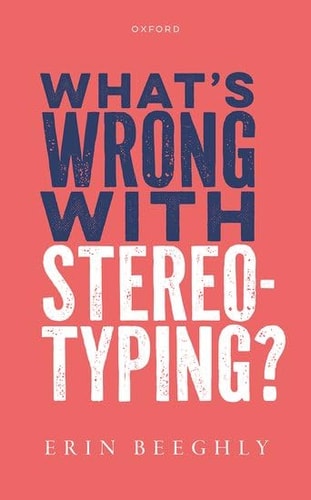
What's Wrong with Stereotyping?
0
0
As an Amazon Associate and affiliate partner, Menrva Books earns from qualifying purchases. Learn more
Author Description
What's Wrong with Stereotyping? offers a refreshing and accessibly written philosophical take on the ethics of stereotyping. Stereotyping is woven into every aspect of human experience: conversation, psychology, algorithmic systems, and culture. It relates to generalization and induction, core aspects of rationality. But when and why it is morally wrong to stereotype? This book tackles this deep and enduring puzzle. To solve it, Erin Beeghly delves into the relationship between stereotyping and another phenomenon, discrimination. Not only does stereotyping cause discriminatory treatment, she argues, stereotyping can itself be discriminatory. This insight-that to stereotype is to discriminate-enables a novel philosophical methodology, which builds towards a theory of wrongful stereotyping by analyzing the lived experiences of marginalized groups and existing theories of wrongful discrimination.Core chapters evaluate important ethical wrongs: the failure to treat persons as individuals, disrespect, harm, prejudice, threats to freedoms, and the failure to treat persons as equals. One finds that there is no "essence" of wrongful stereotyping, a single property or set of properties that all problematic cases share in common. Nor are the wrongs of stereotyping reducible to an elegant number, two or three. Instead, wrongful stereotyping is a messy normative kind characterized by clusters of wrong-making properties, including all the ones noted here (and perhaps more). Readers will come away with a radically pluralistic, open-ended theory of wrongful stereotyping that they can use to identify wrongful stereotyping in their own lives and our contemporary world. Filled with thought-provoking examples and models for social change, this book emphasizes the messiness of moral reality and the importance of looking to the past in order to understand the ethical perils of stereotyping.
Menrva's Summary
THE THESIS
This book investigates the moral dimensions of stereotyping by questioning when and why the act of generalizing becomes ethically impermissible. Erin Beeghly, a philosopher, utilizes a methodology that bridges the gap between cognitive psychology and social ethics. She argues that stereotyping is not merely a precursor to discrimination but is, in many instances, a form of discrimination itself. By examining the lived experiences of marginalized groups alongside established theories of justice, Beeghly constructs a pluralistic framework for identifying wrongful stereotyping.
THE SCOPE MAP
What You Will Find
- An analysis of the relationship between cognitive induction and moral wrongdoing.
- A multi-faceted framework identifying clusters of wrong-making properties such as disrespect, prejudice, and the failure to treat individuals as equals.
- A critique of the search for a single essence of stereotyping, favoring a pluralistic normative approach.
- Practical models for identifying and addressing stereotyping in contemporary social and algorithmic contexts.
THE AUTHORITY PERSPECTIVE
Experts in moral philosophy and social ethics recognize this text as a significant contribution to the study of bias and discrimination. Readers frequently note that the prose is accessible to non-specialists while maintaining the rigorous analytical standards required for academic discourse.
Page Count:
272
Publication Date:
2025-05-27
Publisher:
Oxford University Press
ISBN-10:
0198829663
ISBN-13:
9780198829669
Philosophy
Psychology
Politics
Social Science
Ethics & Morality
Ethics
Sociology
Community Tags
Other Editions(3)

Similar Books













Reader Comments
Share Your Thoughts
No comments yet. Be the first to share your thoughts!