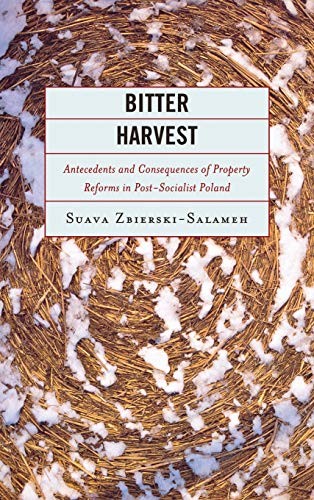
Bitter Harvest
0
0
As an Amazon Associate and affiliate partner, Menrva Books earns from qualifying purchases. Learn more
Author Description
This book links political and economic sociology examining how postsocialist property changes are rooted in the socialist past and how they relate to the meaning and practices of transition states and their capacity for sustainable economic development. It raises the issue of the applicability of Western institutions in the Eastern European context and the implications for the contemporary politics of European integration in which EU politics aim to smooth over the many divergences of its members
Menrva's Summary
THE THESIS
This book investigates the enduring influence of socialist pasts on post-socialist property transformations and their impact on the trajectory of transition states. The author, Suava Zbierski-Salameh, draws upon political and economic sociology to analyze how historical legacies shape contemporary economic development and the capacity for sustainable growth. It critically examines the transferability of Western institutions into the Eastern European context, questioning their efficacy and exploring the implications for the ongoing process of European integration.
THE SCOPE MAP
- Analysis of postsocialist property changes rooted in the socialist past.
- Examination of the meaning and practices of transition states.
- Assessment of the capacity for sustainable economic development in post-socialist economies.
- Discussion on the applicability of Western institutions in Eastern Europe.
- Implications for contemporary politics of European integration.
- Exploration of how EU politics navigate member state divergences.
THE AUTHORITY PERSPECTIVE
The book offers a nuanced sociological perspective on the complex transitions following socialism, particularly focusing on property relations and their long-term economic consequences. It challenges simplistic assumptions about the universal applicability of Western economic models in Eastern European contexts. The work is likely to appeal to scholars and students of sociology, economics, and political science interested in post-Soviet transformations and European integration.
Page Count:
304
Publication Date:
2012-01-01
ISBN-10:
0739165135
ISBN-13:
9780739165133
Economics
Politics
Science
Non-Fiction
European integration
Sociology