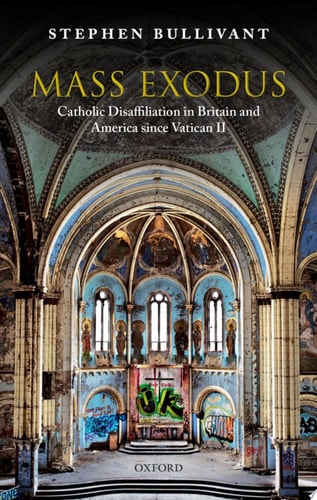
Mass Exodus: Catholic Disaffiliation in Britain and America since Vatican II
0
0
As an Amazon Associate and affiliate partner, Menrva Books earns from qualifying purchases. Learn more
Author Description
In 1962, Pope John XXIII opened the Second Vatican Council with the prophecy that 'a new day is dawning on the Church, bathing her in radiant splendour'. Desiring 'to impart an ever increasing vigour to the Christian life of the faithful', the Council Fathers devoted particular attention to the laity, and set in motion a series of sweeping reforms. The most significant of these centred on refashioning the Church's liturgy 'the source and summit of the Christian life' in order to make 'it pastorally efficacious to the fullest degree'.Over fifty years on, however, the statistics speak for themselves. In America, only 15 percent of cradle Catholics say that they attend Mass on a weekly basis; meanwhile, 35 percent no longer even tick the 'Catholic box' on surveys. In Britain, the signs are direr still. Of those raised Catholic, just 13 percent still attend Mass weekly, and 37 percent say they have 'no religion'. But is this all the fault of Vatican II, and its runaway reforms? Or are wider social, cultural, and moral forces primarily to blame? Catholicism is not the only Christian group to have suffered serious declines since the 1960s. If anything Catholics exhibit higher church attendance, and better retention, than most Protestant churches do. If Vatican II is not the cause of Catholicism's crisis, might it instead be the secret to its comparative success?Mass Exodus is the first serious historical and sociological study of Catholic lapsation and disaffiliation. Drawing on a wide range of theological, historical, and sociological sources, Stephen Bullivant offers a comparative study of secularization across two famously contrasting religious cultures: Britain and the USA.
Menrva's Summary
THE THESIS
This book investigates whether the decline in Catholic affiliation and church attendance in Britain and the United States since the Second Vatican Council is a direct result of the Council's reforms or a consequence of broader secularization trends. Stephen Bullivant, a professor of theology and the sociology of religion, utilizes a rigorous comparative framework to analyze demographic data and historical shifts within the Church. He challenges the common narrative that Vatican II caused the current crisis, instead positioning the Church's experience within the wider context of global religious decline.
THE SCOPE MAP
What You Will Find
- Comparative analysis of Catholic retention rates in Britain and the United States.
- Historical examination of the reforms enacted during the Second Vatican Council.
- Sociological data regarding Mass attendance and religious self-identification.
- Evaluation of external social and cultural factors influencing religious disaffiliation.
THE AUTHORITY PERSPECTIVE
Experts recognize this work as a significant contribution to the sociology of religion, providing a balanced, data-driven perspective on a contentious ecclesiastical topic. Readers frequently note the academic density of the prose, which makes it a foundational text for those studying contemporary religious trends.
Page Count:
336
Publication Date:
2019-07-30
Publisher:
Oxford University Press
ISBN-10:
0198837941
ISBN-13:
9780198837947
Religion
History
United States
Sociology
Secularization
Catholicism
Great Britain
Community Tags
Similar Books